Ductless Mini Splits Sussex WI: What Homeowners Must Know
One cold bedroom in January can cost you more than comfort. When one room never heats up, homeowners often crank the thermostat for the whole house or plug in a space heater. That drives up energy bills and still leaves the problem room cold. For many families, ductless mini splits Sussex WI homeowners install are the fix, because they deliver targeted heating and cooling without new ductwork.
Our team at Emergency Plumbing Bob’s has spent years working in New Jersey’s freezing winters and aging homes. The cold-climate lessons we’ve learned apply directly to Wisconsin houses.
Key Takeaways
- Ductless mini splits heat and cool individual rooms with no ductwork. They suit additions, sunrooms, basements, and bonus rooms that your central system can’t reach.
- Cold-climate models keep full heating output down to 5°F and keep running to -13°F, so they can handle Waukesha County winters.
- Proper sizing, condensate drainage, and yearly maintenance matter as much as the brand. A poor install can leak water and waste energy.
Below, we cover costs, efficiency ratings, installation steps, plumbing risks, and maintenance. If you’re comparing options for a whole-home upgrade, our HVAC installation services page explains how we approach system planning and transparent pricing.
What Is a Ductless Mini Split?
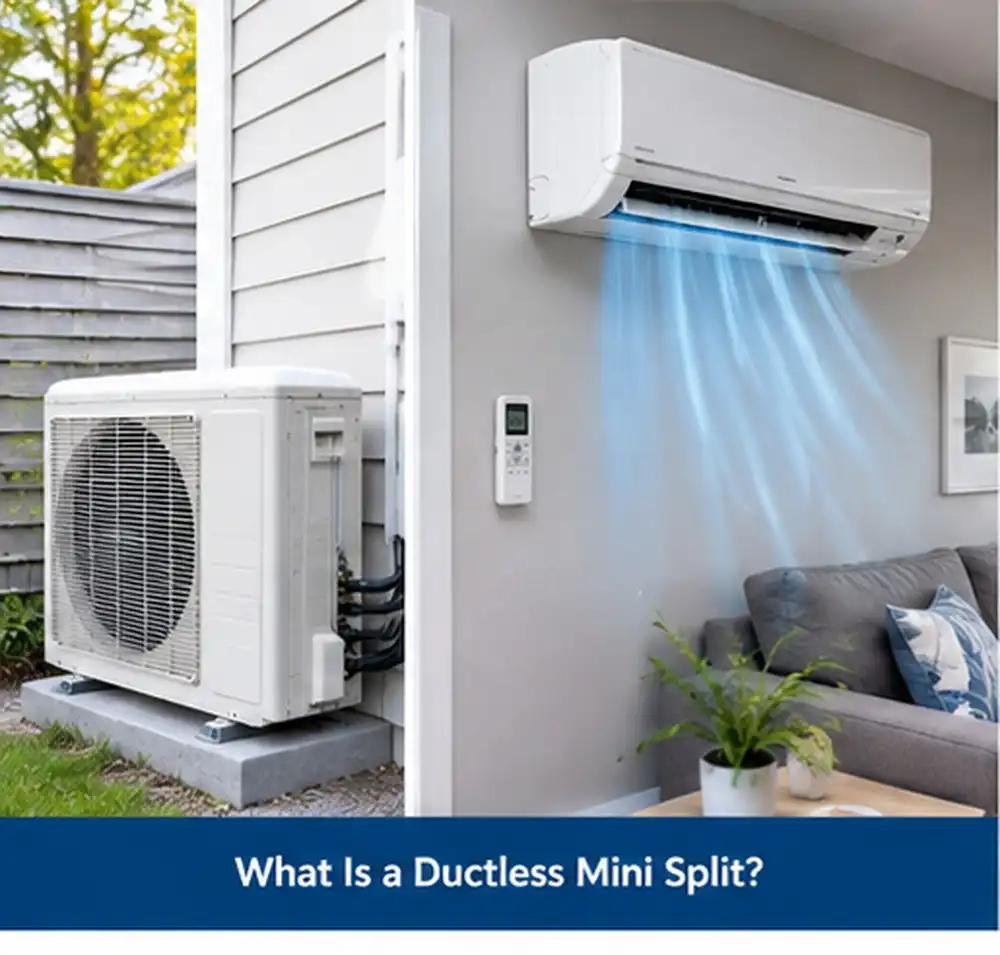
A ductless mini split is a heat pump with two main parts. An outdoor compressor connects to one or more indoor air handlers through a small wall opening. Refrigerant lines, a power cable, and a condensate drain run through that opening.
| Component | Where It Sits | What It Does |
|---|---|---|
| Outdoor unit (compressor) | Exterior pad or wall bracket | Moves heat in or out of the home |
| Indoor head (air handler) | High on an interior wall | Blows conditioned air into the room |
| Line set | Through a 3-inch wall hole | Carries refrigerant between units |
| Condensate line | Alongside the line set | Drains moisture away from the indoor unit |
| Remote or wall controller | In each room | Sets temperature for that zone only |
Each indoor head runs independently. That means you can keep a home office cool while a guest room sits idle. You only pay to condition the rooms you use.
Check Also: Slab Leak Repair Lake Elsinore: Protect Your Home’s Foundation
Why Ductless Mini Splits Sussex WI Homes Benefit From
Sussex grew fast through the 1990s and 2000s. Many homes are subdivision colonials, two-stories, and ranches from that era. Plenty of them have limited ductwork, or rooms that were added after the original HVAC system was sized.
Here’s what we see most often in homes like these:
- Bonus rooms over garages that bake in July and freeze in February
- Sunrooms and four-season rooms with big glass walls and no duct runs
- Finished basements that feel damp in summer and chilly in fall
- Additions built without extending the main trunk line
- Upper floors that run 5 to 10 degrees warmer than the main level
Our plumbers frequently see the same pattern in older New Jersey homes. The central system works fine for the main floor but can’t push air to the far rooms. Extending ductwork means opening ceilings and walls, which gets expensive fast. A mini split skips that demolition entirely.
Single-Zone vs. Multi-Zone: Choose the Right Design
A single-zone system pairs one outdoor unit with one indoor head. A multi-zone system connects one outdoor unit to two to five indoor heads. The right choice depends on how many rooms truly need independent comfort.
| Factor | Single-Zone | Multi-Zone |
|---|---|---|
| Best for | One problem room | Several rooms with different needs |
| Outdoor units | 1 per room | 1 for up to 5 rooms |
| Install time | About 4 to 6 hours | Usually 1 full day |
| Design complexity | Simple | Needs careful load matching |
| Efficiency | Highest per room | Slightly lower if heads run at low loads |
| Failure risk | Affects one room | One compressor failure affects all zones |
Our advice: start with the rooms that cause the most complaints. Sometimes one zone solves everything. Other times, a multi-zone plan costs less than buying three separate systems. Don’t let anyone sell you more heads than your home needs.
Cost Comparison: What You Can Expect to Pay
Pricing for ductless mini splits Sussex WI homeowners get quoted varies with brand, capacity, line set length, and electrical work.

The ranges below are typical installed estimates for the Midwest market. Always get a written, itemized quote.
| System Type | Typical Installed Cost Range | Notes |
|---|---|---|
| Single-zone, standard | $3,000 to $5,500 | Good for mild-use rooms |
| Single-zone, cold-climate | $4,500 to $7,500 | Rated for heating to -13°F |
| Dual-zone | $7,000 to $11,000 | Two rooms, one outdoor unit |
| Three to four zones | $10,000 to $18,000 | Common for bonus room plus basement |
| Whole-home (5 zones) | $15,000 to $25,000+ | Often replaces baseboard heat |
How Ductless Compares to Other Options
| Option | Upfront Cost | Operating Cost | Comfort Level |
|---|---|---|---|
| Space heater + window AC | Low ($200 to $800) | High | Poor and noisy |
| Extending existing ductwork | $2,000 to $8,000+ | Medium | Depends on central system capacity |
| Electric baseboard heat | $400 to $1,500 per room | Very high | Heat only, no cooling |
| Ductless mini split | $3,000 to $7,500 per zone | Low | Quiet, year-round control |
Cost drivers to ask about:
- Electrical upgrades (a new 240V circuit or panel space)
- Line set length beyond the standard 15 to 25 feet
- Condensate pump if gravity drainage isn’t possible
- Wall brackets or snow stands for the outdoor unit
- Permit fees from the village or county
Financing and utility rebates can shrink that upfront number noticeably.
Check Also: How Slab Leak Repair Menifee Homeowners Choose Protects Floors, Walls, and Water Bills
Efficiency Ratings: What the Numbers Mean
Efficiency labels confuse most homeowners. SEER2 measures cooling efficiency. HSPF2 measures heating efficiency. Higher numbers mean lower utility bills.
| Rating | What It Measures | Federal Minimum (North) | Strong Performer |
|---|---|---|---|
| SEER2 | Seasonal cooling efficiency | About 14.3 | 16 to 30+ |
| EER2 | Cooling efficiency at peak heat | Varies by size | 12+ |
| HSPF2 | Seasonal heating efficiency | About 7.5 | 9 to 11+ |
| COP at 5°F | Heating efficiency in deep cold | Not required | 1.75+ for cold-climate models |
According to the latest efficiency guidance from ENERGY STAR certified heat pumps, certified models beat federal minimums and often qualify for rebates and tax credits. Look for the cold-climate designation if you plan to heat through a Wisconsin winter. Many premium ductless mini splits Sussex WI installers recommend carry SEER2 ratings above 20.
Why ductless beats ducted systems on efficiency:
- No duct losses: leaky ducts can waste 20 to 30 percent of conditioned air
- Inverter compressors: they ramp up and down instead of cycling on and off
- Zoning: empty rooms don’t get heated or cooled
- Quiet operation: indoor heads often run near 20 to 25 decibels
Efficiency on paper only matters if the system is sized and installed correctly.
Cold-Climate Performance: Built for Wisconsin Winters
If you’ve spent a freezing winter in New Jersey, you know why heating capacity in deep cold matters. Southeast Wisconsin is even tougher. January lows routinely hit single digits, and subzero nights aren’t rare.
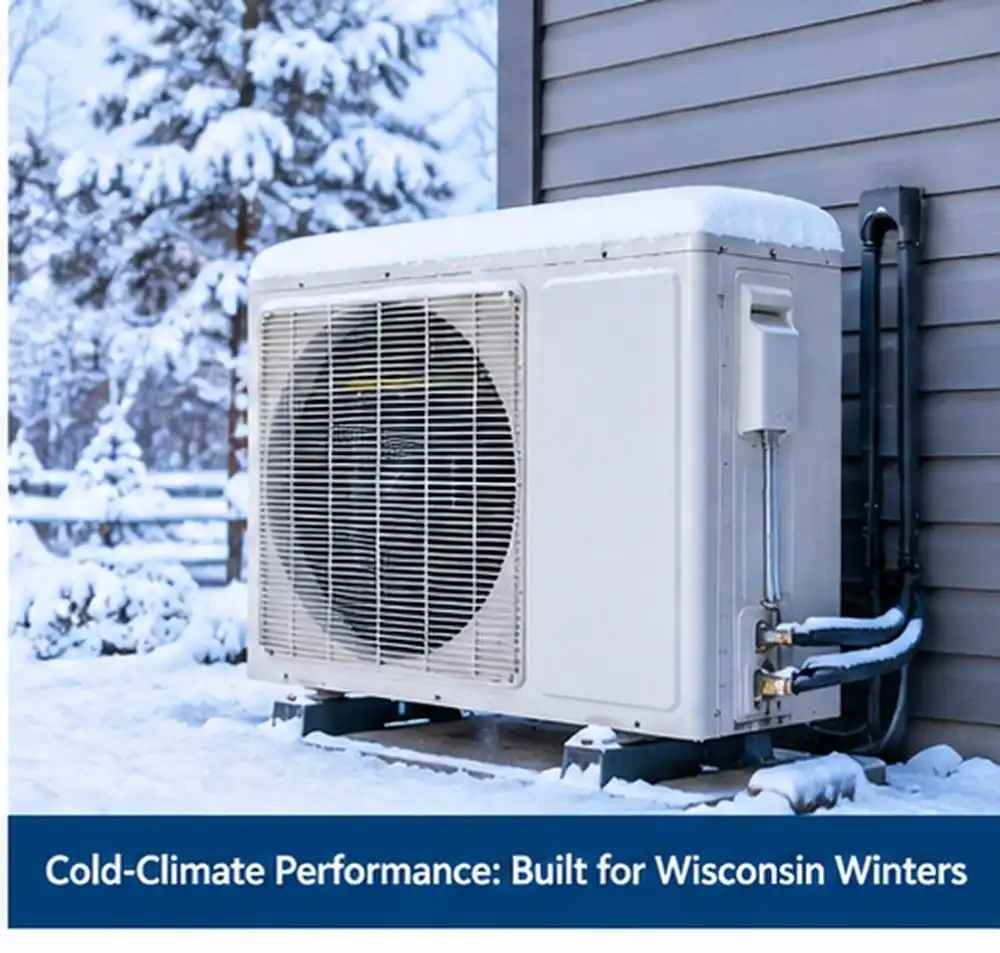
Standard heat pumps lose capacity fast below freezing. Cold-climate models, like Hyper-Heating inverter systems, hold full rated output down to 5°F. They keep running down to -13°F.
| Outdoor Temperature | Standard Mini Split | Cold-Climate Mini Split |
|---|---|---|
| 47°F | 100% capacity | 100% capacity |
| 17°F | Roughly 60 to 75% | 100% capacity |
| 5°F | Roughly 40 to 60% or shutoff | 100% capacity |
| -13°F | Typically stops heating | Still operating |
That’s why many ductless mini splits Sussex WI families rely on serve as a primary heat source in additions and bonus rooms. Others use them to take load off an aging furnace. For a whole-home primary heat plan, ask about backup heat for the rare -20°F night.
Outdoor Unit Placement for Snow and Ice
- Mount the unit 12 to 24 inches above grade on a stand or wall bracket
- Keep it away from roof drip lines where ice can fall or form
- Leave clear airflow on all sides
- Plan where defrost meltwater will drain so it doesn’t freeze on walkways
Check Also: Sewer Line Repair Vista: What It Means for Your NJ Home
Best Applications for Sussex WI Homes
Not every room needs a mini split. These spaces get the biggest payoff:
| Space | Common Problem | Why Ductless Works | Typical Size |
|---|---|---|---|
| Sunroom / four-season room | Too hot in summer, too cold in winter | Handles big glass heat loads | 9,000 to 12,000 BTU |
| Bonus room over garage | Poor airflow, exposed floor | Direct heat and cooling | 9,000 to 12,000 BTU |
| Finished basement | Damp, chilly, no ducts | Dry mode controls humidity | 9,000 to 18,000 BTU |
| Garage / workshop | Unconditioned space | Year-round usable shop | 12,000 to 18,000 BTU |
| Home office | Overheats from equipment | Independent daytime cooling | 6,000 to 9,000 BTU |
| Room addition | Never tied into main system | No duct extension needed | 9,000 to 15,000 BTU |
Garages need extra care. If the insulation is poor or the door opens often, the unit works much harder. Insulate first, then size the equipment.
Warning Signs Your Home Needs a Mini Split
On recent service calls, we hear the same complaints again and again.
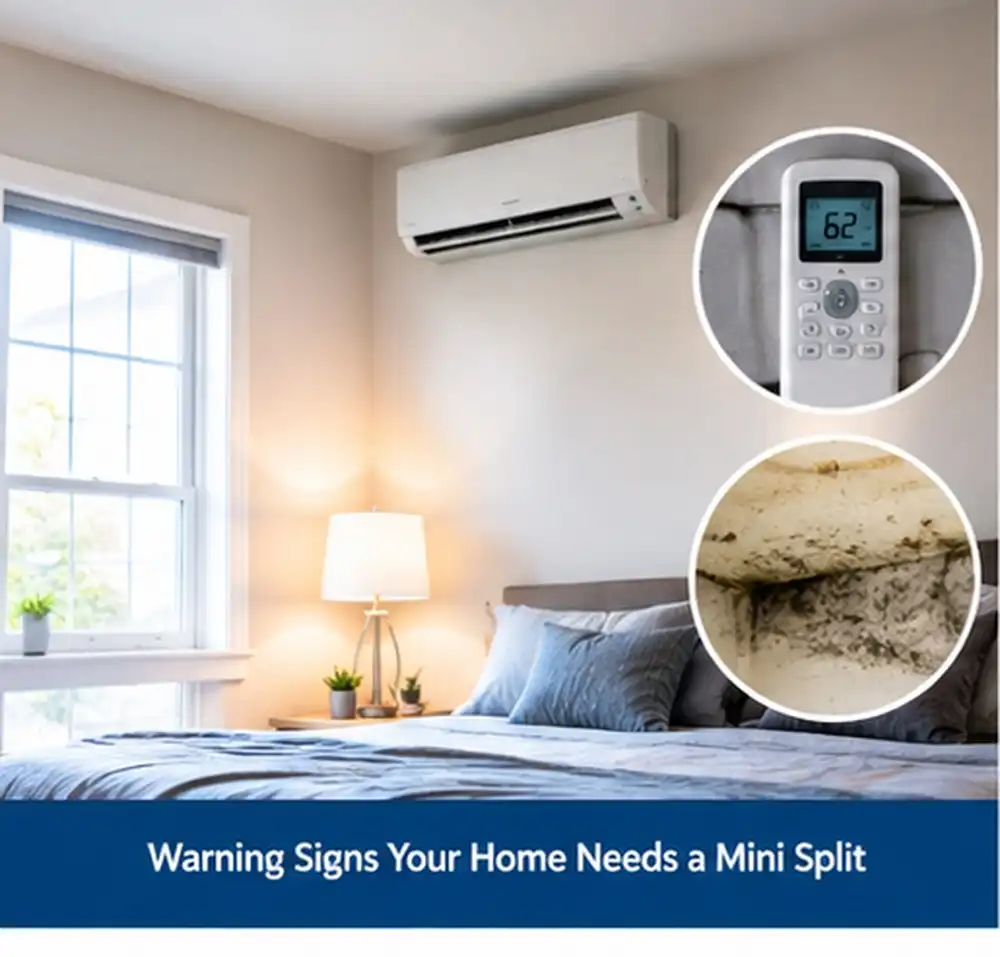
If any of these sound familiar, a ductless system may be the answer:
- Hot or cold spots that never match the rest of the house
- Space heaters or window units running every season
- Rising energy bills with no improvement in comfort
- A planned addition or basement finish with no ductwork
- Loud equipment that drowns out conversation
- Electric baseboard heat with sky-high winter bills
If your existing equipment is failing instead of just falling short, start with professional heating and cooling repair before deciding to add new equipment. Sometimes a fix to the main system solves part of the problem.
The Installation Process, Step by Step
A quality install follows a clear sequence. Here’s what to expect:
- Load calculation: the technician measures square footage, insulation, windows, and sun exposure.
- Equipment selection: match BTU capacity to the room, not a guess.
- Indoor head placement: high on a wall, away from direct drafts on beds or desks.
- Wall penetration: a single 3-inch hole, sloped slightly down to the outside.
- Line set and drain routing: refrigerant lines, power, and condensate line run together.
- Outdoor unit mounting: on a stand or bracket above snow level.
- Electrical connection: a dedicated circuit with a disconnect switch.
- Vacuum and pressure test: removes moisture and checks for refrigerant leaks.
- Startup and commissioning: confirm airflow, charge, and drainage.
- Walkthrough: learn the remote, filters, and modes.
| Install Type | Typical Time | Crew Size |
|---|---|---|
| Single-zone | 4 to 6 hours | 1 to 2 techs |
| Multi-zone (2 to 4 heads) | 1 full day | 2 techs |
| Whole-home (5 heads) | 1 to 2 days | 2 to 3 techs |
Skipping the vacuum step is one of the most common shortcuts, and it shortens equipment life.
The Plumbing Side: Condensate Drains and Water Damage

This is where our plumbing background matters most. Every mini split pulls moisture from the air in cooling mode. A single indoor head can produce several gallons of water per day in humid weather.
That water has to go somewhere. When the condensate line fails, it ends up on your walls, floors, and ceilings.
| Drain Problem | What You’ll Notice | Risk Level | Fix |
|---|---|---|---|
| Clogged drain line | Water dripping from indoor head | High | Flush line, clear algae |
| Poor slope | Gurgling, slow drips | Medium | Re-pitch the line |
| Frozen exterior outlet | Backup in winter | High | Reroute or add heat tape |
| Failed condensate pump | Sudden overflow | High | Replace pump, add float switch |
| Kinked line in wall | Hidden wall stains | Very high | Open wall, reroute |
How to prevent water damage:
- Make sure the drain line has a steady downward slope
- Terminate the outlet away from foundations and walkways
- Install a safety float switch on any condensate pump
- Flush the line with a mild vinegar solution each cooling season
- Watch for brown stains or bubbling paint below indoor heads
A small drip ignored for a summer can mean drywall, insulation, and mold repairs by fall.
Repair vs. Replace: Make the Smart Call
Quality mini splits last 15 to 20 years with good care.
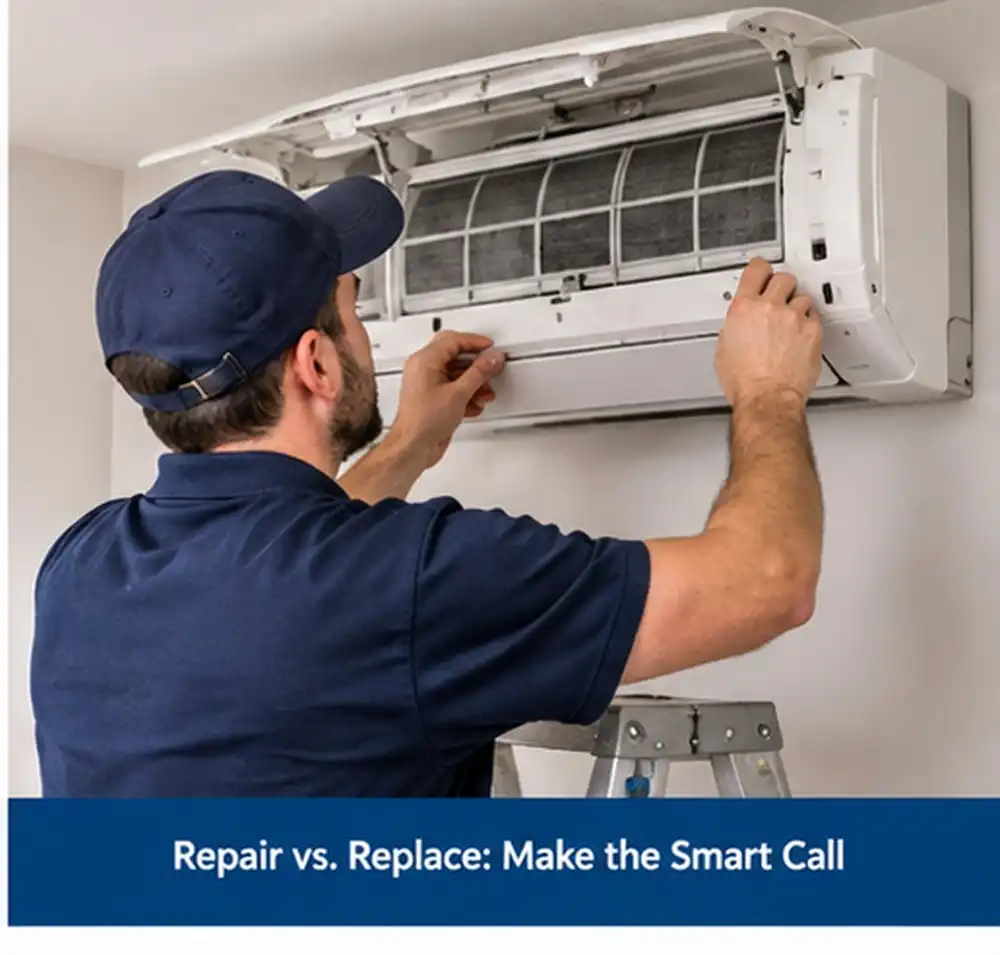
Use this table to decide when a repair still makes sense.
| Situation | Repair | Replace |
|---|---|---|
| System age under 10 years | ✅ Usually | Rarely |
| System age over 15 years | Only minor fixes | ✅ Often |
| Repair cost over 50% of new unit | No | ✅ Yes |
| Refrigerant leak, one-time | ✅ Yes | No |
| Repeated refrigerant leaks | No | ✅ Yes |
| Failed compressor out of warranty | Rarely | ✅ Usually |
| Clogged drain or dirty coil | ✅ Yes | No |
| Older model with low SEER | Possible | ✅ Upgrade saves money |
| Component | Typical Lifespan |
|---|---|
| Compressor | 15 to 20 years |
| Indoor fan motor | 10 to 15 years |
| Condensate pump | 3 to 7 years |
| Remote control | 5 to 10 years |
| Reusable filters | Life of unit with cleaning |
If repairs are stacking up every season, put that money toward a high-efficiency replacement.
Maintenance Checklist
Good maintenance keeps efficiency high and water off your floors. Here’s a simple schedule:
Monthly (homeowner):
- Rinse and dry the reusable filters
- Wipe dust from the indoor head louvers
- Check below each head for drips or stains
Seasonally (homeowner):
- Clear leaves, snow, and ice from the outdoor unit
- Confirm the condensate outlet flows freely
- Test heating mode before the first hard freeze
Annually (professional):
- Deep-clean the indoor coil and blower wheel
- Flush and inspect the condensate line and pump
- Check refrigerant pressures and electrical connections
- Inspect line set insulation for cracks or UV damage
Many ductless mini splits Sussex WI owners skip the blower wheel cleaning. That’s a mistake. A dirty blower wheel causes musty smells, weak airflow, and drain clogs.
People also ask things like this?
How much does a ductless mini split cost in Sussex, WI?
Most single-zone systems run $3,000 to $7,500 installed. Multi-zone systems range from $7,000 to $25,000 or more, depending on the number of heads.
Can a mini split heat my home through a Wisconsin winter?
Yes, if you choose a cold-climate model. These keep full output to 5°F and keep running to -13°F.
How long does installation take?
A single-zone install usually takes 4 to 6 hours. A multi-zone system typically takes one full day.
Do mini splits need much maintenance?
Clean the filters monthly and schedule a professional tune-up once a year. Keep the condensate line clear.
Why is my mini split leaking water?
The usual causes are a clogged drain line, poor slope, or a failed condensate pump. Shut the unit off and call a pro to avoid water damage.
Are mini splits loud?
No. Indoor heads often run near 20 to 25 decibels, which is quieter than a whisper.
Will I qualify for rebates?
Many ENERGY STAR certified and cold-climate models qualify for utility rebates and federal incentives. Check eligibility before you buy.
The Bottom Line for Sussex Homeowners
A room that never feels right doesn’t need a bigger furnace or a louder window unit. It needs targeted, efficient comfort. The best ductless mini splits Sussex WI homes use pair cold-climate performance with proper sizing and smart drainage. Get those three right, and you’ll enjoy lower bills and quiet comfort for 15 years or more.
Start with one step: list the rooms that bother you most, then get a load calculation before you buy anything. When you’re ready to talk through options, our home comfort services team at Bob’s Emergency Plumbing gives honest, jargon-free advice. We’ll tell you what your home actually needs, and what it doesn’t.