
Sewer Line Repair Vista: What It Means for Your NJ Home
A broken sewer line almost never fails all at once. It starts with a slow tub, a gurgling toilet, or a faint sewage smell near the basement floor drain. Then one morning, wastewater comes up through the lowest drain in the house. Homeowners researching sewer line repair Vista options face the same buried-pipe problems we handle every week in New Jersey: tree roots, brittle old pipe, and soil that keeps moving.
Below, we cover the warning signs, the real causes, repair methods, typical costs, and who pays. Catching a cracked pipe early is the difference between a spot repair and a flooded, contaminated basement.
Key Takeaways
- Book a camera inspection before any digging. Repeated snaking without seeing inside the pipe wastes money and hides the real defect.
- Full replacement is often unnecessary. Spot repairs and trenchless lining fix many localized defects with far less yard damage.
- The private lateral is usually yours. In Vista and most NJ towns, the pipe from your house to the public main is the homeowner’s responsibility.
Why Sewer Line Repair Vista Cases Mirror New Jersey

Vista, California, and older New Jersey towns sit 2,500 miles apart. Their buried pipes still fail for nearly the same reasons. The City of Vista runs more than 215 miles of sewer collection pipe, and the Buena Sanitation District manages about 101 more miles.
Local records cited by area plumbers show 27 sewage spills over five years. Iron mains installed in the 1980s, designed for 50 years, began failing in just over half that time. One failure near Buena Vista Lagoon released more than 7.3 million gallons of effluent.
The private laterals tied to those mains are the same age and material. That pattern sounds familiar to us. Our plumbers frequently see this in older NJ homes, where original clay and cast-iron laterals from the 1940s through the 1970s still carry waste every day.
The lesson is simple: diagnose before you dig. Routine drain cleaning services keep a healthy line flowing, but cleaning can’t fix a cracked or sagging pipe. For that, we need to see inside it.
Vista vs. New Jersey: Same Pipe, Different Stress
| Factor | Vista, CA | New Jersey |
|---|---|---|
| Main soil stress | Expansive clay swells and shrinks | Freeze-thaw frost heave |
| Seasonal pattern | Wet Nov-Mar, dry Apr-Oct | Freezing winters, wet springs |
| Common old laterals | Clay, cast iron | Clay, cast iron, Orangeburg |
| Root pressure | Mature trees seek water in dry season | Old maples and oaks in established suburbs |
| City system issue | Aging iron mains, past spills | Combined sewers in older cities |
| Lateral ownership | Homeowner, by city ordinance | Usually homeowner, varies by town |
Warning Signs Your Main Sewer Line Is Failing
One clogged sink usually means a branch-line clog. When multiple fixtures act up together, the main line is the likely suspect.

Use this table to judge how fast you need help.
| Symptom | What It Usually Means | Urgency |
|---|---|---|
| Several drains slow at once | Blockage in the shared main line | High |
| Toilet gurgles when the washer drains | Air pushed back by a partial blockage | Medium-High |
| Sewage odor indoors, no clear source | Cracked pipe or failed seal | High |
| Backup in basement floor drain or lowest shower | Main line blocked or broken | Emergency |
| Soggy, sunken, or extra-green lawn strip | Underground leak feeding the soil | Medium-High |
| Clogs return weeks after snaking | Roots, a belly, or structural damage | High |
| Rodents or insects near drains | Breach in the pipe wall | High |
Quick Troubleshooting Steps Before You Call
- Test one fixture at a time. If only one drain is slow, it’s likely a local clog.
- Flush a toilet and watch the tub. Rising water in the tub points to the main line.
- Open the cleanout cap carefully. Standing water inside means the blockage is downstream.
- Skip chemical drain cleaners. They rarely reach main-line clogs and can eat at older pipe.
- Write down what happens and when. Notes speed up diagnosis on the service call.
On recent emergency calls in New Jersey, homeowners who tracked their symptoms got answers faster. Small details, like which drain backs up first, often point straight to the problem area.
What Actually Causes Sewer Lines to Fail
Nearly every sewer line repair Vista homeowners schedule traces back to a short list of causes. The same list applies to aging NJ neighborhoods.
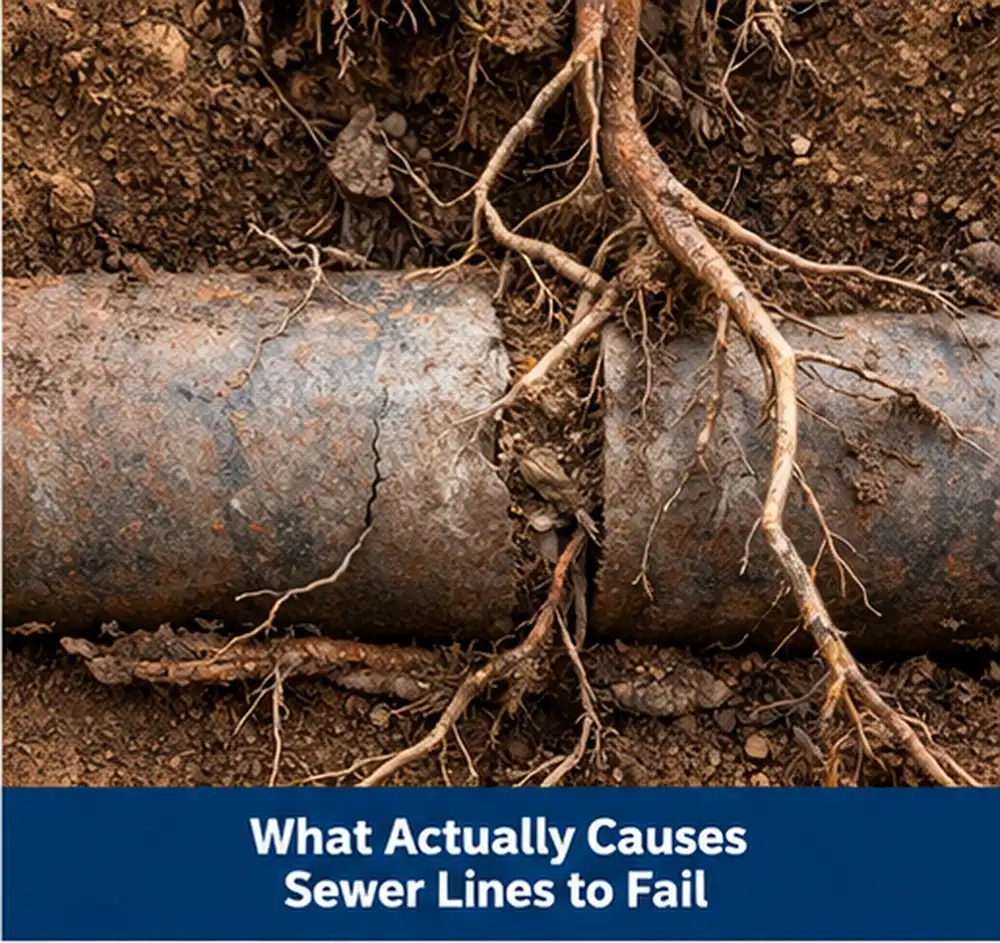
Here’s how each one works.
Tree Root Intrusion
Roots chase moisture and nutrients. A sewer lateral carries water every day, so it’s the most reliable source underground. Roots slip into loose joints or hairline cracks, then grow into a thick mat that traps paper and waste.
Snaking cuts them back for a few months. On an old clay line, they always come back. Mature trees cause this constantly in older NJ suburbs, just as they do along Vista’s historic downtown streets.
Aging Pipe Materials
Pipe material is the strongest predictor of how much life a line has left. Older materials crack, corrode, or collapse long before modern plastic does.
| Pipe Material | Common Install Era | Typical Lifespan | Most Common Failure |
|---|---|---|---|
| Orangeburg (tar paper) | 1940s-1970s | 30-50 years | Blistering, flattening, collapse |
| Clay (vitrified) | Pre-1980s | 50-75 years | Joint separation, root intrusion |
| Cast iron | Pre-1980s | 50-75 years | Internal corrosion, scale, cracking |
| ABS plastic | 1970s-present | 50-100 years | Joint issues if poorly installed |
| PVC | 1970s-present | 70-100+ years | Rare; heavy loads or bad joints |
| HDPE (trenchless) | Modern | 50-100 years | Very rare; seamless and root-resistant |
If your home was built before 1980 and the lateral was never replaced, assume it’s clay, cast iron, or Orangeburg until a camera proves otherwise.
Soil Movement and Pipe Bellies
Vista’s clay-heavy soil swells in the rainy season and shrinks through the long dry summer. That yearly cycle pulls joints apart and creates bellies, which are low spots where water and solids settle.
New Jersey’s version is the freeze-thaw cycle. If you’ve spent a freezing winter in New Jersey, protecting your pipes makes complete sense. Frost heave lifts and drops the soil around shallow pipe, causing the same offset joints and sags.
Grease, Wipes, and Daily Habits
Not every failure is structural. Grease, coffee grounds, and so-called flushable wipes narrow the pipe over time. In a line that already has a belly or offset joint, buildup speeds up every other problem.
In short: roots, old material, moving soil, and buildup work together. Fixing one without checking the others rarely lasts.
Our Step-by-Step Sewer Repair Process
At Bob’s Emergency Plumbing, we follow a diagnose-first workflow. Good sewer line repair Vista crews and NJ plumbers alike should follow the same order.
- Symptom review. We ask which fixtures are affected, check for a cleanout, and review past backups.
- Camera inspection. A high-resolution camera goes through the cleanout to spot roots, cracks, offsets, bellies, or collapse.
- Locating. A locator marks the exact depth and position of the defect in your yard.
- Options and upfront pricing. We explain spot repair, lining, bursting, or replacement, with costs in writing.
- Permits and code. Many towns require a permit for lateral work, so we plan for it early.
- Repair. We complete the approved method with the least disruption possible.
- Verification scan. The camera goes back in to confirm the fix and full flow.
- Prevention plan. You get maintenance advice based on what we found.
Watching the footage yourself takes the guesswork out of a big decision. You decide with the same information our technicians have.
Repair vs. Replacement: Which Does Your Line Need?
Not every damaged pipe needs to come out. The camera shows whether a targeted fix will hold or the whole line is failing.
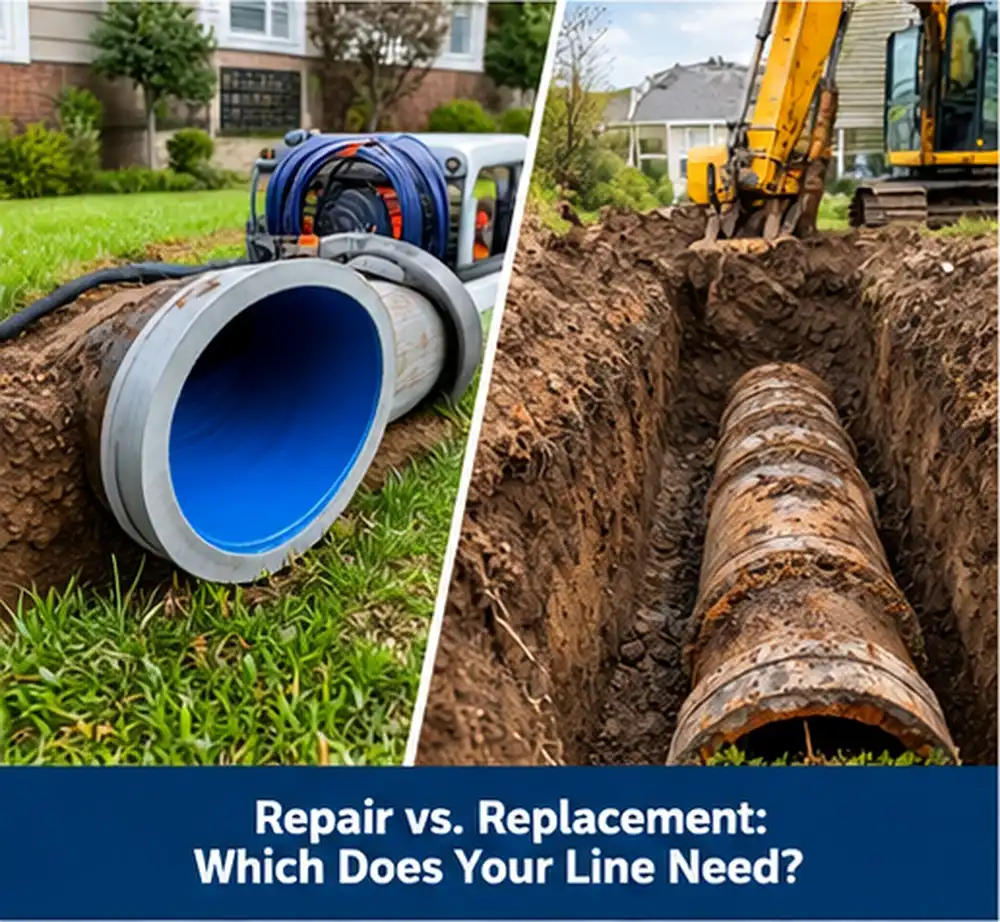
Every sewer line repair Vista homeowners or NJ property managers approve should rest on these factors.
| Factor | Repair Makes Sense | Replacement Makes Sense |
|---|---|---|
| Damage extent | One crack, joint, or short section | Multiple failing sections |
| Pipe material | PVC or ABS in good shape | Orangeburg, badly corroded cast iron |
| Pipe age | Under 40 years | 50+ years with recurring issues |
| Root problems | Single entry point | Roots at many joints |
| Backup history | First or rare issue | Repeated backups despite cleaning |
| Pipe grade | Proper slope | Major bellies or grade loss |
| Typical cost | $500-$4,000 | $4,000-$25,000+ |
| Expected result | Defect fixed, rest of line ages normally | New line with decades of life |
Our Rule of Thumb
- Repair when the rest of the line looks healthy on camera.
- Line or burst when damage repeats along the run but alignment holds.
- Replace by excavation when the pipe is collapsing, Orangeburg, or out of grade.
Trenchless vs. Traditional Excavation
The question we hear most is, “Do you have to dig up my whole yard?” Often, the answer is no. Here’s how the main methods compare.
| Feature | Traditional Excavation | Pipe Lining (CIPP) | Pipe Bursting |
|---|---|---|---|
| How it works | Dig a trench, remove and replace pipe | Resin-soaked liner cured inside old pipe | New HDPE pipe pulled through, breaking old pipe outward |
| Digging required | Full trench length | 1-2 small access points | 2 small access pits |
| Typical timeline | 2-5 days plus restoration | 1-2 days | 1-2 days |
| Yard/driveway impact | Heavy | Minimal | Minimal |
| Fixes bellies/grade | Yes | No | Limited |
| Works on collapsed pipe | Yes | No | Usually yes |
| Design life | 50-100 years | About 50 years | 50-100 years |
| Root resistance | Depends on material | Seamless, highly resistant | Seamless, highly resistant |
Trenchless Pros and Cons
Pros:
- Protects landscaping, patios, and driveways
- Often finished in a day or two
- Seamless pipe that keeps roots out
- Lower restoration costs afterward
Cons:
- Can’t correct a badly bellied line
- Lining slightly reduces pipe diameter
- Lining won’t work on fully collapsed sections
- Requires specialized equipment and skill
Traditional Excavation Pros and Cons
Pros:
- Corrects slope and grade problems
- Lets crews add new cleanouts
- Works in any pipe condition
- Best for very shallow lines
Cons:
- Tears up lawn, hardscape, or driveway
- Longer project timeline
- Higher restoration costs
- Disturbed soil may settle unevenly later
When sewage is already coming into your home, method choice comes second. Calling for emergency plumbing stops the damage and contamination first. Then we diagnose and plan the permanent fix. A fast response protects your floors, walls, and family’s health.
Sewer Repair Cost Comparison

Costs depend on pipe depth, length, surface access, and local permit fees. The ranges below reflect typical national pricing for sewer line repair Vista and New Jersey homeowners see. Your written quote should come after a camera inspection, never before.
| Service | Typical Cost Range | Best For |
|---|---|---|
| Camera inspection | $150-$500 | Diagnosis, home purchases |
| Mechanical snaking (main line) | $150-$450 | Simple clogs, temporary root cutting |
| Hydro jetting | $350-$800 | Grease, scale, root mats in sound pipe |
| Spot repair (single section) | $1,000-$4,000 | One crack or joint |
| Pipe lining (CIPP) | $80-$250 per foot | Cracked but aligned pipe |
| Pipe bursting | $60-$200 per foot | Deteriorated or partly collapsed pipe |
| Full excavation replacement | $50-$250 per foot plus restoration | Bellied lines, grade correction |
| Backwater valve install | $1,000-$2,500 | Basement backup protection |
What Drives Your Final Price
- Depth: Deeper pipe means more labor and trench shoring.
- Surface: Concrete, asphalt, and pavers cost more to open and restore.
- Length: Long laterals on large lots raise totals.
- Permits: Municipal fees and inspections vary by town.
- Timing: After-hours emergency calls can carry higher rates.
- Frozen ground: NJ winter digs may need extra equipment.
Trenchless work is often cited as roughly 40% less in total cost than full excavation once restoration is counted. Don’t plan around averages, though. Your pipe’s actual condition sets the real number.
Common Mistakes That Make Sewer Problems Worse
The search for sewer line repair Vista homeowners can trust usually starts after a few costly missteps. Avoid these:
- Snaking over and over without a camera inspection
- Pouring chemical cleaners into a main-line clog
- Assuming the city will pay for problems on your lateral
- Ignoring a soggy lawn strip because drains still work
- Planting trees directly over the sewer path
- Buying an older home without a pre-purchase sewer scan
- Choosing the cheapest bid that skips diagnosis and permits
On recent emergency calls in New Jersey, we’ve met homeowners who spent more on repeated snaking than a spot repair would have cost. One camera visit would have saved them hundreds.
What to Do During an Active Sewer Backup
A backup is a health hazard. Sewage carries bacteria and pathogens. Act fast and stay safe.
- Stop all water use. No flushing, laundry, dishwasher, or showers.
- Keep kids and pets away from affected areas.
- Ventilate the space if odors are strong.
- Avoid contact with standing water. Wear gloves and boots if you must go in.
- Clear access to your cleanout.
- Take photos for your insurance claim.
- Call a licensed plumber right away.
Who’s Responsible: Homeowner or City?
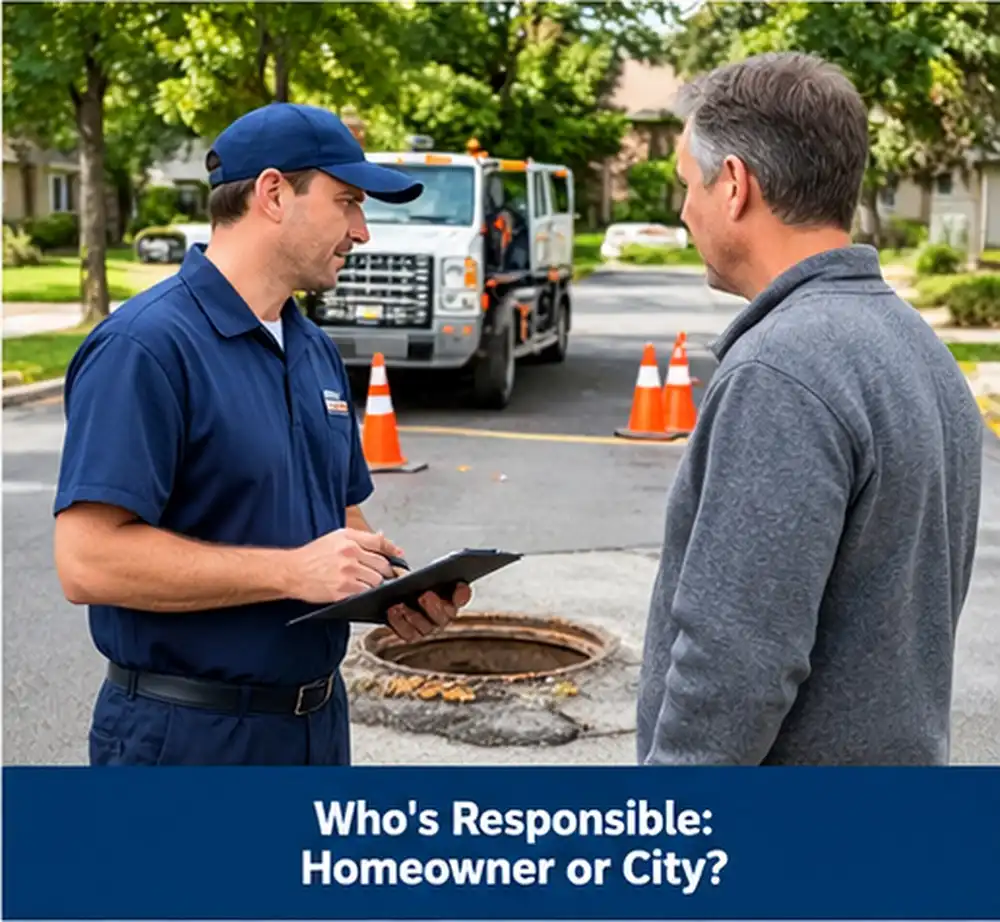
Your home connects to the public sewer through a private sewer lateral. Under Vista city ordinance, residents maintain the entire lateral, including the connection to the main. Most New Jersey municipalities use a similar split, though the exact line varies.
| Pipe Section | Typical Owner | Who Pays for Repair |
|---|---|---|
| Interior drains and stack | Homeowner | Homeowner |
| Lateral from house to property line | Homeowner | Homeowner |
| Lateral from property line to main | Varies by town | Check local ordinance |
| Public sewer main | Municipality or utility | Municipality |
A camera inspection shows whether the defect sits on your side or the city’s. That single finding can save you thousands.
New Jersey’s public systems carry their own age burden. Many older cities still run combined sewers that carry stormwater and wastewater in one pipe. The NJ DEP Division of Water Quality explains how the state regulates wastewater and combined sewer overflows during heavy rain and snowmelt. When public mains are stressed, a backwater valve on your lateral becomes cheap insurance.
Sewer Line Maintenance Checklist
Prevention costs less than any repair. This checklist helps any homeowner avoid needing sewer line repair Vista style emergencies, whether you live in California or New Jersey.
Every Month
- Wipe greasy pans with paper towels before washing
- Use drain strainers in tubs and sinks
- Flush only toilet paper and human waste
Every Year
- Walk the sewer path and look for wet or sunken spots
- Pour a bucket of water into basement floor drains to keep traps sealed
- Confirm the cleanout cap is sealed and easy to reach
Every 18-24 Months
- Schedule professional main-line cleaning or hydro jetting
- Book a camera inspection if your home is 40+ years old
- Trim back or relocate trees growing over the lateral
Before Winter in New Jersey
- Disconnect and drain outdoor hoses
- Insulate exposed pipes in crawl spaces and garages
- Test sump pumps and backwater valves
The EPA’s WaterSense home maintenance checklist pairs well with this list. It helps you catch indoor leaks and wasted water before they add load to your drains.
FAQs
How long does sewer line repair take?
A camera inspection takes about an hour. Spot repairs often finish in one visit. Trenchless jobs usually take 1-2 days, while full excavation can run several days plus restoration.
Can roots be cleared without replacing the pipe?
Yes, for a while. Hydro jetting removes roots and buildup in sound pipe. If roots enter through cracked joints, they will grow back, so lining or a spot repair is the lasting fix.
Is trenchless repair always cheaper?
Not always on materials alone. It often costs less overall because you skip lawn, driveway, and landscape restoration.
How do I know if it’s a clog or a broken pipe?
One slow drain is usually a clog. Multiple slow drains, gurgling toilets, or backups in the lowest fixture point to the main line. Only a camera confirms a break.
Does homeowners insurance cover sewer line repair?
Standard policies often exclude it. Many insurers offer a service line or sewer backup rider. Check your policy before you need it.
Should I inspect the sewer before buying a house?
Yes. A pre-purchase scan costs a few hundred dollars and can reveal a five-figure problem. The footage also gives you leverage in negotiations.
How long will a new sewer line last?
Modern PVC and HDPE lines can last 50 to 100 years when installed correctly. Cured-in-place liners typically carry about a 50-year design life.
The Bottom Line on Protecting Your Sewer Line
Whether you’re comparing sewer line repair Vista quotes or nursing along a 70-year-old clay lateral in New Jersey, the path is the same. See inside the pipe first. Match the fix to the actual defect. Choose trenchless when the pipe’s alignment allows it, and dig only when grade problems or collapse demand it.
Remember the three big points. Camera diagnosis beats guesswork. Full replacement isn’t always needed. The private lateral is usually yours to maintain. Small warning signs today are far cheaper than a basement full of sewage tomorrow.
Your next step is simple. If you notice slow drains in several fixtures, gurgling, or a soggy lawn strip, book a camera inspection now. When the footage shows damage that cleaning can’t fix, our team at Bob’s Emergency Plumbing will walk you through sewer line repair and replacement options with clear, upfront pricing and plain-English answers.