

A single frozen pipe can release hundreds of gallons of water before you notice the damage. In Central Wisconsin, where January nights often drop well below zero, that risk shows up every winter. Good plumbing Stevens Point homeowners can count on starts with prevention, fast emergency response, and honest pricing. This post shows you what repairs cost, how to choose a plumber, and which maintenance steps stop water damage early.
Our plumbers see the same freeze-thaw failures in older New Jersey homes that Stevens Point homeowners deal with each winter. Burst supply lines, cracked water heater tanks, and backed-up floor drains follow the same pattern in every cold-climate town. The fix is almost always cheaper when you catch it early. If water is already on the floor, our emergency plumbing services page explains what to do first and how to reach a technician fast.
Key Takeaways
- Know where your main shutoff valve is today. Closing it within minutes of a leak is the biggest factor in limiting water damage.
- Budget for after-hours rates. Emergency calls in Stevens Point often cost 1.5 to 2 times the standard hourly rate, so a yearly inspection pays for itself.
- Upgrade to WaterSense fixtures when you replace toilets, faucets, or showerheads. You cut water use by 20% or more per fixture with no loss in performance.
Why Stevens Point Plumbing Faces Tougher Conditions
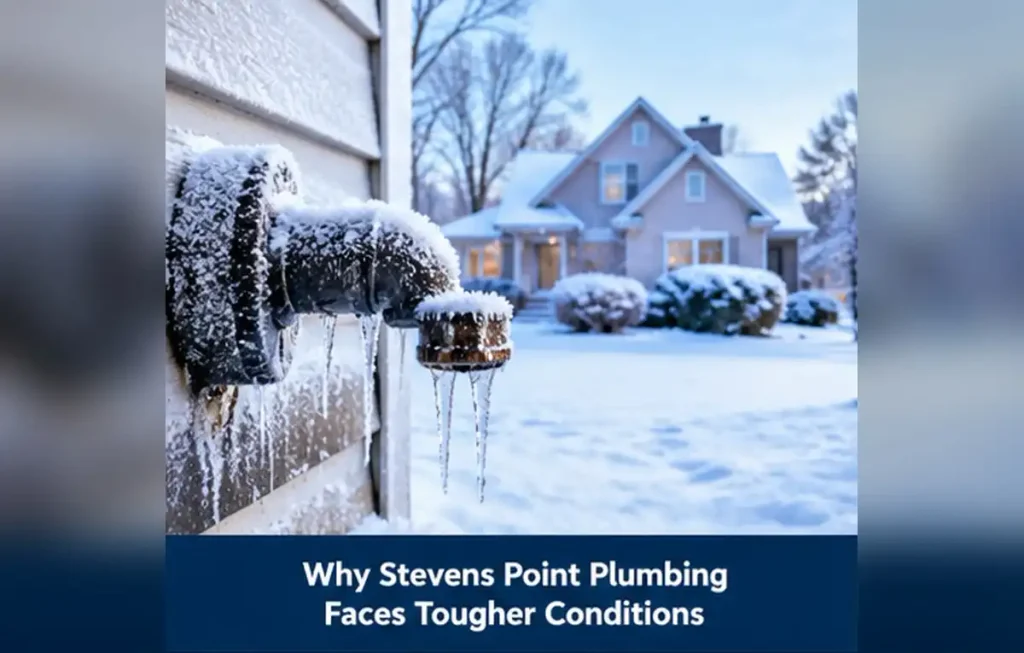
Stevens Point plumbing works harder than plumbing in milder climates. Deep frost, hard water, and older housing stock combine to stress every pipe in the house. Here is what drives most service calls.
| Local Factor | What It Means for Your Plumbing | Common Result |
|---|---|---|
| Frost depth of 4 to 5+ feet | Water and sewer lines must be buried deep | Frozen service lines during long cold snaps |
| Sub-zero January lows | Pipes in exterior walls, crawl spaces, and garages freeze | Burst pipes, split fittings |
| Hard water (common in Central WI groundwater) | Minerals build up inside pipes and tanks | Low water pressure, short water heater life |
| Older homes near downtown and campus | Galvanized steel and cast iron still in service | Corrosion, rust-colored water, slow drains |
| Private wells in rural Portage County | Pumps, pressure tanks, and filters need upkeep | Pressure swings, pump failures |
| Spring snowmelt | High groundwater pushes against foundations | Sump pump overload, basement flooding |
Older pipes plus extreme cold is the most expensive combination we see. Our plumbers frequently find galvanized supply lines in homes built before 1960. These lines corrode from the inside, so they look fine on the outside until they fail.
Your next step: Walk your basement and note any pipe that runs along an exterior wall. Those are your highest-risk spots.
Plumbing Stevens Point Prices: What Common Repairs Cost
Plumbing prices depend on the job, the time of day, and access to the problem. The table below shows typical 2026 ranges for plumbing Stevens Point households pay. Use these as planning numbers, then get a written quote before work starts.
| Service | Typical Cost Range | What Raises the Price |
|---|---|---|
| Service call / trip fee | $75 – $150 | Rural distance, after-hours |
| Standard hourly labor | $85 – $150/hour | Master plumber vs. journeyman |
| After-hours or holiday labor | 1.5x – 2x standard rate | Nights, weekends, storms |
| Sink or tub clog | $125 – $300 | Deep clog, older pipes |
| Main sewer line snaking | $200 – $500 | Tree roots, no cleanout access |
| Hydro jetting | $350 – $800 | Grease buildup, line length |
| Sewer camera inspection | $150 – $400 | Often bundled with cleaning |
| Burst pipe repair | $200 – $1,000+ | Wall or ceiling access, drywall work |
| Toilet repair | $100 – $300 | Wax ring, flange damage |
| Faucet replacement | $150 – $350 | Fixture cost, shutoff valve condition |
| Water heater repair | $150 – $600 | Gas valve, element, thermostat |
| Tank water heater replacement (40-50 gal) | $1,300 – $3,000 installed | Venting, code upgrades, permits |
| Tankless water heater install | $2,500 – $5,000+ | Gas line upsizing, venting |
| Sump pump replacement | $500 – $1,500 | Battery backup, new pit |
| Water softener install | $1,000 – $3,000 | Unit size, plumbing changes |
How to Keep Your Plumbing Bill Fair
Transparent pricing protects you. We tell every customer the same thing: ask these questions before the plumber picks up a tool.
- Ask for the trip fee and whether it applies toward the repair.
- Request flat-rate pricing for common jobs like drain clearing.
- Confirm the after-hours rate before agreeing to a night call.
- Get the quote in writing, including parts and permit fees.
- Ask about warranties on both labor and parts.
Your next step: Save this table and compare it against any quote you receive.
24 Hour Plumbing in Stevens Point: What Counts as an Emergency
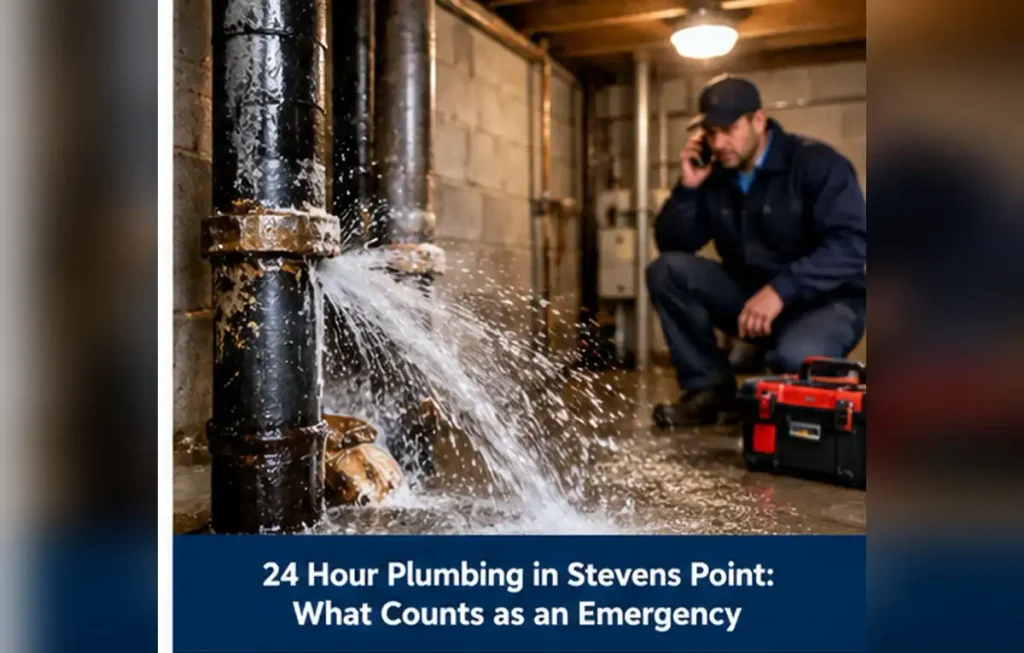
A plumbing emergency is any problem that causes active water damage, sewage backup, or loss of heat-related water service. Not every issue needs a 2 a.m. call. Knowing the difference saves you money.
| Situation | Emergency? | What to Do |
|---|---|---|
| Burst or frozen pipe leaking | Yes | Shut off main valve, call now |
| Sewage backing up into basement | Yes | Stop using water, call now |
| Water heater leaking from tank | Yes | Shut off water and power/gas |
| No water at all in winter | Yes | Likely frozen line, call now |
| Gas smell near water heater | Yes | Leave the house, call gas utility |
| One slow drain | No | Schedule a standard visit |
| Dripping faucet | No | Schedule a standard visit |
| Running toilet | No | Close toilet shutoff, schedule repair |
Steps to Take Before the Plumber Arrives
On recent emergency calls, the homeowners who acted in the first five minutes had the smallest repair bills. Follow these steps in order.
- Shut off the main water valve. It usually sits where the water line enters the basement, near the meter.
- Turn off the water heater. Switch off the breaker for electric units or set gas units to “pilot.”
- Stay clear of electrical outlets and breaker panels if water is near them.
- Open the lowest faucet to drain pressure from the lines.
- Move valuables and electronics out of the water path.
- Take photos and video for your insurance claim.
- Call a licensed plumber and describe exactly what you see.
How to Thaw a Frozen Pipe Safely
If you’ve spent a freezing winter in Central Wisconsin, you know frozen pipes are a matter of when, not if. Use gentle heat only.
- Do: Open the faucet, then warm the pipe with a hair dryer or heating pad.
- Do: Open sink cabinet doors so room heat reaches the pipes.
- Do: Start warming at the faucet end and work back toward the frozen spot.
- Don’t: Use a torch, propane heater, or any open flame.
- Don’t: Leave space heaters unattended near pipes.
- Don’t: Wait if you can’t find the frozen section. Call a pro.
Your next step: Tag your main shutoff valve with a bright label today so anyone in the house can find it.
Mobile Plumbing Stevens Point Residents Can Use
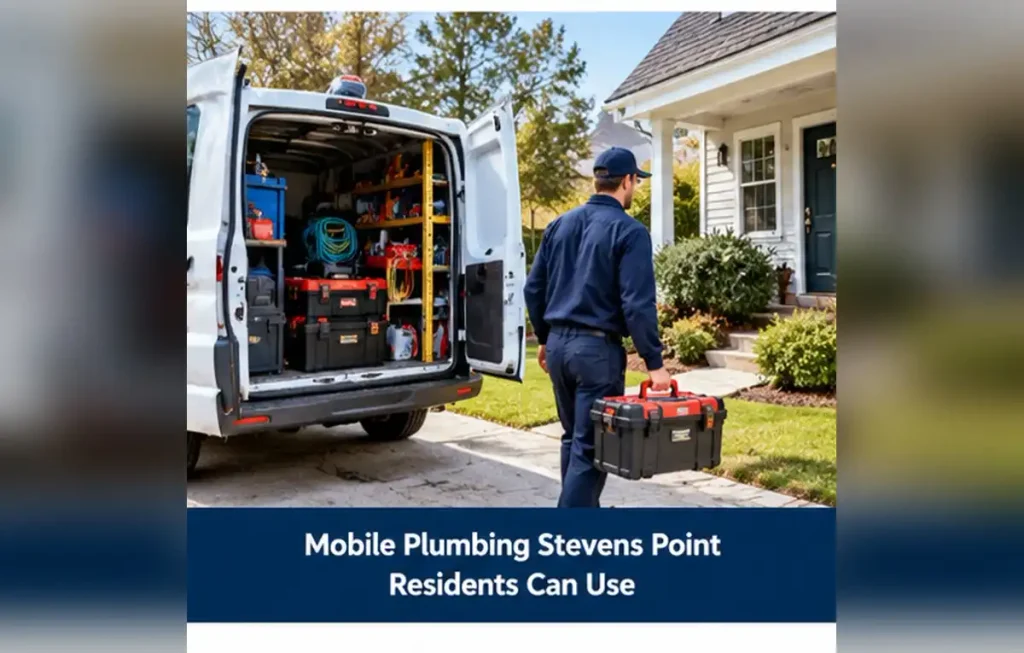
Mobile plumbing means the plumber brings a stocked service van to your door. Most plumbing Stevens Point shops run mobile crews, so the real question is what the van carries. A well-stocked truck fixes more problems on the first visit.
| What a Good Service Van Carries | Why It Matters |
|---|---|
| Drain snakes and augers | Clears most clogs in one visit |
| Sewer camera | Shows root intrusion and pipe breaks |
| Common water heater parts | Thermocouples, elements, valves |
| PEX and copper fittings | Fast burst pipe repairs |
| Pipe thawing equipment | Safe thawing of frozen lines |
| Wet vac and moisture meter | Limits water damage on site |
Ask this on the phone: “Will the technician have parts for my problem on the truck?” A yes usually means one trip fee instead of two.
How to Choose the Best Plumbing in Stevens Point
The best plumber is licensed, insured, and clear about pricing. Star ratings help, but they don’t tell the whole story. Wisconsin requires plumbers to hold a license through the Department of Safety and Professional Services (DSPS), and you can verify any license online.
Local Plumbing Companies Homeowners Research
These are names that come up often when people search for best plumbing Stevens Point options. We are not affiliated with any of them. Bob’s Emergency Plumbing is also a separate company from Bob’s Plumbing & Heating of Central Wisconsin, so check the name carefully when you call.
| Company | How Homeowners Find Them | What to Confirm Before You Book |
|---|---|---|
| Chet’s Plumbing (Stevens Point) | Local referrals, company website | Current service area and emergency hours |
| Klasinski (Stevens Point) | Long-standing local name, website | Plumbing vs. heating and cooling scheduling |
| Abrahamson Plumbing LLC | Website, local reviews | Residential vs. commercial availability |
| Excel Plumbing Stevens Point | Search listings, directories | License number and insurance |
| Bob’s Plumbing & Heating of Central Wisconsin | 50+ years in the area, maintenance plans | Plan details and inspection scope |
| Steve’s Plumbing | MapQuest and directory listings | Hours and services offered |
| Water heater pros (hotwater.com locator) | Manufacturer contractor finder | Brand training and warranty support |
Where to Check Reviews and Credentials
- BBB listings: Look at complaint history and how the company responded.
- Yelp and Google reviews: Read the 3-star reviews. They are usually the most honest.
- Names and Numbers directory: Good for finding phone numbers and addresses fast.
- Wisconsin DSPS license lookup: Confirms the plumber is actually licensed.
- Local Facebook groups: Neighbors often share who showed up on time and charged fairly.
Red Flags to Avoid
- No written estimate before work starts
- Cash-only payment with no invoice
- Pressure to replace when a repair is reasonable
- No license number on the truck, website, or invoice
- Vague answers about warranties
Your next step: Save two vetted plumbers in your phone now, one for regular work and one for emergencies.
Plumbing Maintenance Checklist for Stevens Point Homes
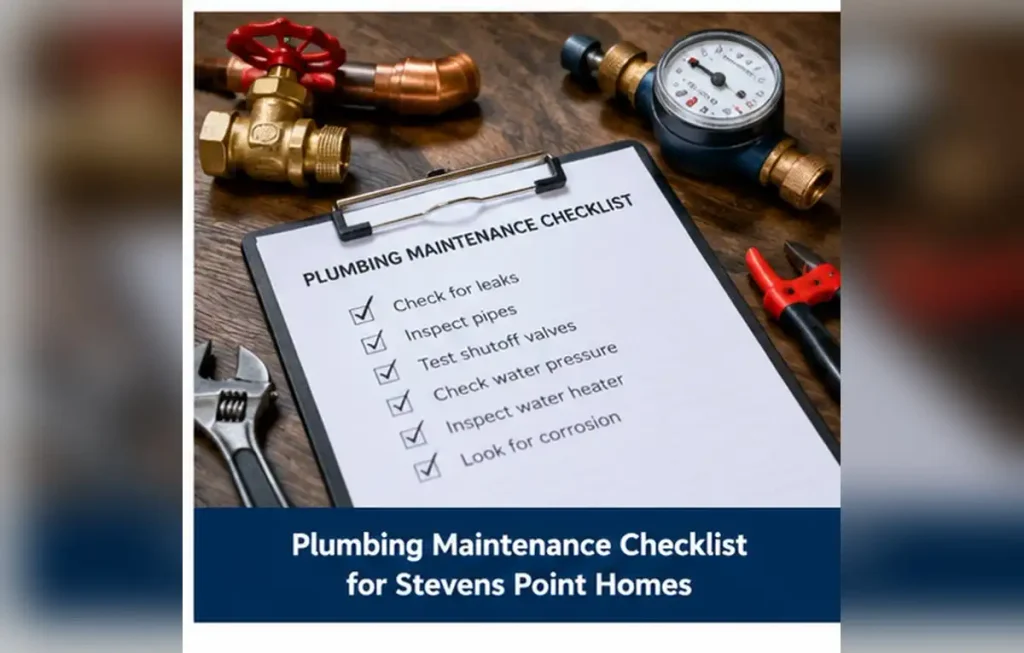
Preventive maintenance catches small problems before they become floods. Our plumbers frequently see this in older homes: a $15 part that failed and caused $5,000 in damage. A seasonal routine keeps that from happening to you.
Fall Checklist (Before the First Hard Freeze)
- Disconnect garden hoses and drain outdoor spigots.
- Shut off and drain interior valves feeding outdoor faucets.
- Insulate exposed pipes in crawl spaces, garages, and exterior walls.
- Seal gaps where pipes enter the house.
- Test your sump pump by pouring a bucket of water into the pit.
- Flush your water heater to clear sediment.
Winter Checklist
- Keep the thermostat at 55°F or higher, even when you travel.
- Drip faucets on exterior walls during sub-zero nights.
- Open cabinet doors under sinks on outside walls.
- Check for ice dams that can push water into walls.
Spring Checklist
- Inspect outdoor spigots for splits from winter freezing.
- Run the sump pump before snowmelt peaks.
- Check the basement floor drain for slow flow.
- Look for water stains on ceilings and walls.
Summer Checklist
- Test water pressure with a gauge. Aim for 40 to 80 psi.
- Check under sinks for drips and corrosion.
- Inspect washing machine hoses and replace rubber hoses with braided steel.
- Schedule a sewer camera check if your home has mature trees.
Leak Detection: Find Hidden Leaks Early
A hidden leak is water escaping where you can’t see it: inside walls, under slabs, or in buried lines. The EPA reports that household leaks can waste nearly 10,000 gallons a year in an average home. That water also feeds mold and wood rot.
Signs You Have a Hidden Leak
- Water bill rising with no change in use
- Water meter moving when every fixture is off
- Warm spots on the floor (possible slab leak on hot water lines)
- Musty smell in a closet or cabinet
- Peeling paint or bubbling drywall
- Sound of running water when nothing is on
How to Run a Simple Meter Test
- Turn off every faucet and water-using appliance.
- Read your water meter and write down the number.
- Wait two hours without using any water.
- Read the meter again. Any change means you have a leak.
- Add food coloring to your toilet tanks. Color in the bowl after 15 minutes means a leaking flapper.
Your next step: Run the meter test this weekend. It takes two minutes of effort.
Drain Care: Stop Clogs Before They Back Up
Most clogs come from hair, grease, and soap scum. These build up slowly, so a slow drain is your early warning. Ignoring a slow drain rarely ends well.
Drain Do’s and Don’ts
| Do | Don’t |
|---|---|
| Use mesh strainers in showers and tubs | Pour cooking grease down the sink |
| Scrape plates into the trash | Use chemical drain cleaners often |
| Run hot water after using the garbage disposal | Flush wipes, even “flushable” ones |
| Use a plunger or hand snake for small clogs | Ignore gurgling sounds in drains |
| Schedule a camera check for repeat clogs | Keep snaking the same clog every month |
Chemical drain cleaners create heat that can damage older pipes, especially cast iron and plastic joints. A plunger or a hand snake is safer for the first attempt. If clogs keep coming back, or more than one drain backs up at once, the problem is likely in the main line. That is when professional drain cleaning services with a camera and hydro jetting make sense.
Troubleshoot a Slow Drain
- Remove the stopper and clear any visible hair.
- Plunge the drain with 10 to 15 firm strokes.
- Use a hand snake to reach clogs past the trap.
- Clean the P-trap under the sink with a bucket underneath.
- Call a plumber if multiple drains are slow or water backs up in the tub when you flush.
Repair vs. Replace: How to Decide
The repair-or-replace decision comes down to age, repair cost, and failure risk. A simple rule we use: if a repair costs more than 50% of replacement and the item is past half its lifespan, replace it. The table below covers the decisions homeowners face most.
| Item | Repair When | Replace When |
|---|---|---|
| Tank water heater | Under 8 years, bad element or thermostat | Leaking tank, over 10 years, rusty water |
| Toilet | Flapper, fill valve, or wax ring issue | Cracked bowl or tank, constant clogs |
| Faucet | Worn cartridge or O-ring | Corroded body, outdated finish, high flow |
| Garbage disposal | Jammed, reset button trips | Leaking housing, over 10 years |
| Sump pump | Stuck float switch | Over 7 years, runs constantly |
| Galvanized pipe | Single small leak | Low pressure, rusty water, multiple leaks |
| Cast iron drain | One cracked section | Widespread scaling, repeated backups |
| Sewer line | Roots in one spot | Collapsed or bellied pipe |
Fixture and Pipe Lifespans
Knowing expected lifespans helps you plan instead of panic. Hard water in Central Wisconsin often shortens these numbers, so treat the low end as realistic for unsoftened homes.
| Fixture or Material | Typical Lifespan | Notes for Hard Water Areas |
|---|---|---|
| Tank water heater | 8 – 12 years | Sediment shortens life without flushing |
| Tankless water heater | 15 – 20 years | Needs yearly descaling |
| Toilet | 25+ years | Flappers last 4 – 5 years |
| Faucets | 15 – 20 years | Mineral buildup wears cartridges |
| Garbage disposal | 8 – 15 years | Depends on use |
| Sump pump | 7 – 10 years | Test every spring |
| Water softener | 10 – 15 years | Check resin and salt use |
| Copper pipe | 50 – 70 years | Pinhole leaks in aggressive water |
| PEX pipe | 40 – 50 years | Resists freeze splitting better than copper |
| Galvanized steel pipe | 40 – 60 years | Many local lines are past this range |
| Cast iron drain | 50 – 75 years | Scales and cracks with age |
Your next step: Find the manufacture date on your water heater label. If it’s over 10 years old, start budgeting now.
Water Efficiency Upgrades That Pay Off
Water-efficient fixtures use less water without hurting performance. According to the water efficiency standards from EPA WaterSense, labeled products must use at least 20% less water than standard models and pass independent performance testing. That means lower water bills and less strain on well pumps and septic systems.
| Fixture | Older Models | Current Federal Max | WaterSense Max | Estimated Savings |
|---|---|---|---|---|
| Toilet | 3.5 – 7 gallons per flush | 1.6 gpf | 1.28 gpf | Up to 13,000 gallons/year per family |
| Showerhead | 3 – 5 gpm | 2.5 gpm | 2.0 gpm | About 2,700 gallons/year per family |
| Bathroom faucet | 3+ gpm | 2.2 gpm | 1.5 gpm | 30% less water per use |
| Irrigation controller | Timer-based | N/A | Weather-based | Up to 7,600 gallons/year |
Hot water savings matter twice as much. Every gallon you don’t heat cuts your water heater energy use too. Check your local utility for rebates before you buy, and look for the WaterSense label at the store.
Pros and Cons of Low-Flow Upgrades
Pros:
- Lower water and sewer bills
- Less hot water demand, so lower energy bills
- Less load on private wells and septic fields
Cons:
- Older drain lines may need a stronger flush. Choose high-performance models
- Upfront cost of $150 to $500 per fixture installed
Water Heater Tune-Up: Add Years to Your Tank

A water heater tune-up is a yearly service that removes sediment and tests safety parts. In hard water areas, sediment builds up fast and forces the burner or elements to work harder. That leads to popping noises, higher bills, and early tank failure.
What a Proper Tune-Up Includes
- Flush the tank to remove mineral sediment.
- Test the temperature and pressure (T&P) relief valve, the safety valve that releases excess pressure.
- Inspect the anode rod, a metal rod that attracts corrosion so the tank doesn’t rust.
- Check the burner or heating elements for proper operation.
- Inspect venting on gas units for blockage or back-drafting.
- Set the temperature to 120°F for safety and efficiency.
Warning Signs Your Water Heater Needs Help
| Symptom | Likely Cause | Urgency |
|---|---|---|
| Popping or rumbling | Sediment buildup | Schedule a flush |
| Rusty hot water | Failing anode rod or tank corrosion | Schedule soon |
| Not enough hot water | Bad element, thermostat, or dip tube | Schedule soon |
| Water around the base | Leaking tank or fitting | Call now |
| Pilot keeps going out | Thermocouple or draft issue | Call soon |
| Rotten egg smell in hot water | Anode reacting with well water bacteria | Schedule service |
On recent winter calls, we found that most failed tanks had never been flushed. If yours shows any of these signs, our water heater repair page explains what a technician checks and when replacement makes more sense.
FAQs
How much does a plumber cost in Stevens Point, WI?
Most plumbing Stevens Point jobs start with a $75 to $150 trip fee plus $85 to $150 per hour. After-hours calls cost more. Always get a written quote first.
Is 24-hour plumbing available in Stevens Point?
Yes. Several local shops and service networks offer after-hours emergency calls. Confirm the emergency rate before the technician heads out.
What should I do first in a plumbing emergency?
Shut off the main water valve. Then turn off the water heater and stay away from wet electrical areas. Call a licensed plumber next.
Why does my toilet keep running?
The usual cause is a worn flapper, a misadjusted float, or a tangled lift chain. Lift the tank lid and check those three parts first. A flapper costs under $15.
Why is my water pressure low?
Common causes include mineral buildup, a partly closed shutoff valve, or corroded galvanized pipe. On private wells, check the pressure tank and pump too.
Can I use chemical drain cleaner?
We don’t recommend it. Chemical cleaners can damage older pipes. Use a plunger or hand snake instead.
How do I prevent frozen pipes in Stevens Point?
Insulate exposed pipes, keep heat at 55°F or higher, drip faucets on exterior walls, and shut off outdoor spigots before the first freeze.
How often should I flush my water heater?
Once a year at minimum. Homes with hard water or wells benefit from flushing every six months.
How do I find the best plumbing Stevens Point has to offer?
Check the Wisconsin DSPS license, read BBB and Google reviews, and ask neighbors. Choose the plumber who gives clear written pricing.
Protect Your Stevens Point Home Before the Next Freeze
Strong plumbing comes down to three habits: know your shutoff valve, maintain your system each season, and hire licensed plumbers who price their work honestly. Central Wisconsin winters will test every weak pipe in your home. A little preparation now costs far less than a flooded basement in January.
Start today: label your main shutoff valve, run the two-hour meter test, and check the date on your water heater. Those three steps take less than 30 minutes and protect you from the most common and costly plumbing failures we see.