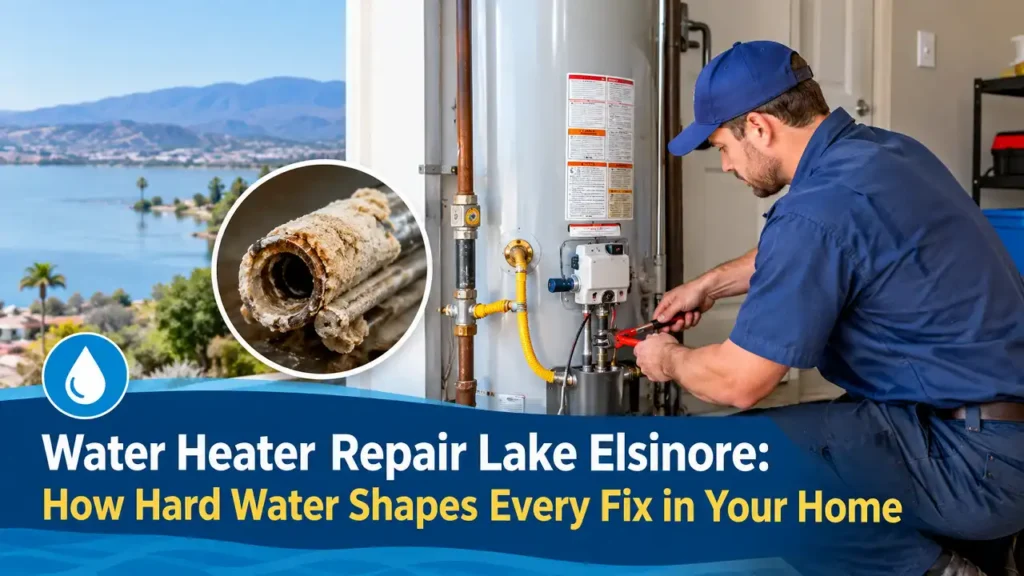
A water heater rarely fails without warning. It rumbles, it reheats slowly, or it leaves a damp ring on the garage floor long before it quits. If you need water heater repair Lake Elsinore homes can count on, the most important fact is this: hard inland water shortens tank life faster than most manufacturers assume. Catching the early signs means a simple part swap instead of a flooded garage and an emergency replacement bill.
Key Takeaways
- Hard water is the top local threat. Sediment and scale cause most of the rumbling, slow reheating, and early failures we see in Riverside County homes.
- Age decides repair vs. replace. Tanks under 8 years with one failed part are worth repairing. Tanks past 10 years with any failure should be replaced.
- Annual flushing pays for itself. One yearly tank flush or tankless descale does more for lifespan in Lake Elsinore than almost anywhere else.
Why Lake Elsinore Water Heaters Fail Early
Lake Elsinore water heaters fail early because of mineral content. Hard water carries calcium and magnesium that settle on the tank floor as sediment. In tankless units, those minerals bake onto the heat exchanger as scale.
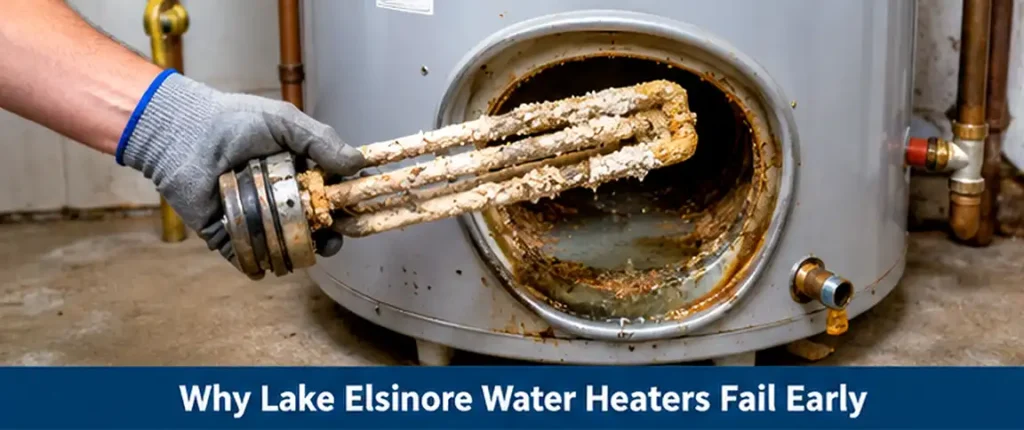
Our plumbers frequently see this pattern in older homes. In New Jersey, our biggest enemy is a frozen pipe in January. In Southern California, the enemy is quieter: a slow, steady layer of minerals that builds every single day.
When you schedule water heater repair, a good technician checks for sediment first. That single inspection explains most symptoms.
Check Also: How Hydro Jetting Chula Vista Protects Your Pipes
How Water Hardness Is Measured
Water hardness is the concentration of dissolved minerals, measured in milligrams per liter (mg/L) or grains per gallon (gpg). The U.S. Geological Survey uses this scale:
| Hardness Level | mg/L (ppm) | Grains per Gallon | Effect on Water Heaters |
|---|---|---|---|
| Soft | 0–60 | 0–3.5 | Minimal sediment |
| Moderately Hard | 61–120 | 3.5–7 | Slow buildup, flush yearly |
| Hard | 121–180 | 7–10.5 | Noticeable sediment, rumbling |
| Very Hard | Over 180 | Over 10.5 | Rapid scale, shortened lifespan |
Inland Riverside County water typically lands in the hard range. Check your water district’s annual Consumer Confidence Report to see your exact number.
What Sediment Does Inside Your Tank
- Insulates the burner. Sediment forms a barrier, so the burner runs longer to heat the same water.
- Traps steam bubbles. Water trapped under sediment boils and pops. That is the rumbling sound.
- Overheats the tank bottom. Extra heat stresses the glass lining and speeds corrosion.
- Reduces capacity. A 50-gallon tank with heavy sediment can act like a 40-gallon tank.
- Clogs the drain valve. Neglected tanks often have valves too clogged to flush.
Pull your Consumer Confidence Report this week and note your hardness level before your next service call.
Lake Elsinore Neighborhoods and What We Find in Each
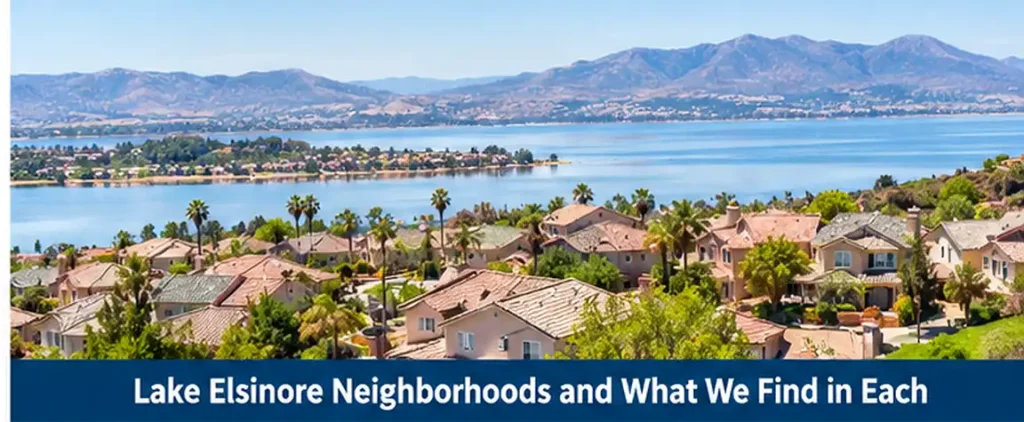
Housing age changes the repair. Our approach to water heater repair Lake Elsinore properties starts with knowing whether the home sits near the lake or up in the newer hillside developments.
| Area | Typical Housing Age | Common Water Heater Issues | Zip Code |
|---|---|---|---|
| Lakeland Village | Older lakeside properties | Tight installs, units past their lifespan, outdated venting | 92530 |
| Older lakeside homes | Pre-1990s | Missing seismic straps, no expansion tank, corroded fittings | 92530 |
| Canyon Hills | 1990s onward | Sediment buildup, tankless descaling, anode wear | 92532 |
| Tuscany Hills | 1990s onward | Tankless error codes, maintenance gaps, scale | 92532 |
Most Lake Elsinore water heaters sit in garages. Newer homes usually have better clearance and modern gas line sizing. Older homes often have cramped closets that make replacement harder and code updates necessary.
Walk out to your garage and note your unit’s location, clearance, and whether you see two metal straps around the tank.
Check Also: Plumbing Stevens Point: What Central Wisconsin Winters Mean for Your Pipes
Common Water Heater Failure Symptoms
Most failures announce themselves weeks in advance. Recognizing the symptom tells you whether you need a quick part repair or a full replacement. Homeowners searching for water heater repair in Lake Elsinore usually call about one of the problems below.
| Symptom | Likely Cause | Typical Fix | Urgency |
|---|---|---|---|
| No hot water (gas) | Pilot out, bad thermocouple, faulty gas valve | Relight pilot or replace thermocouple | Same day |
| No hot water (electric) | Tripped breaker, failed heating element or thermostat | Reset breaker or replace element | Same day |
| Rumbling or popping | Heavy sediment | Flush tank | Within a week |
| Rusty or brown hot water | Depleted anode rod or corroding tank | Replace anode or replace tank | Soon |
| Rotten egg smell | Bacteria reacting with anode rod | Flush and swap anode type | Within a week |
| Water pooling at base | Leaking fitting, valve, or tank body | Tighten/replace fitting, or replace tank | Immediate |
| Relief valve dripping | High pressure or failed T&P valve | Install expansion tank or replace valve | Soon |
| Hot water runs out fast | Sediment, broken dip tube, undersized tank | Flush, replace dip tube, or upsize | Soon |
| Tankless error code | Scale, flame failure, flow sensor issue | Descale or replace sensor | Same day |
Step-by-Step Troubleshooting Before You Call
Try these safe checks first:
- Check the breaker on electric units. Reset once. If it trips again, stop and call.
- Look at the pilot window on gas units. Follow the relight label on the tank.
- Confirm the gas supply. Make sure other gas appliances work.
- Check the thermostat setting. The U.S. Department of Energy recommends 120°F for most homes.
- Inspect the base and fittings for moisture with a flashlight.
- Feel the T&P discharge pipe. A warm or wet pipe signals pressure problems.
- Note any error code on tankless units and photograph it.
If water is actively pouring out, skip troubleshooting and shut everything down first.
What to Do During an Active Leak
- Shut the cold water supply valve on top of the unit.
- Turn the gas control to “Off” or switch off the electric breaker.
- Move stored items away from the water.
- Attach a hose to the drain valve if the tank must be emptied.
- Call for emergency plumbing service right away.
On recent emergency calls in New Jersey, the biggest damage always came from waiting. The same rule applies in Lake Elsinore: stop the water first, then call.
Write down your symptom, the unit’s age, and any error code so the technician can arrive prepared.
Repair or Replace: A Clear Decision Framework
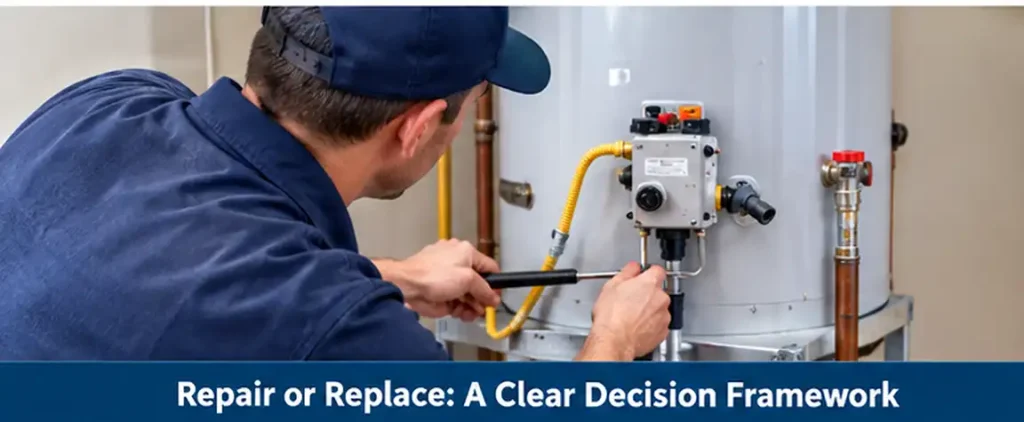
Age is the deciding factor. A failed part on a young tank is worth fixing. Any failure on an old tank signals the end. This is the framework we use for every water heater repair Lake Elsinore homeowners request.
Find Your Water Heater’s Age
The serial number on the rating label encodes the manufacture date. Most brands use a letter for the month and two digits for the year. Search the brand name plus “serial number lookup” to decode yours.
| Situation | Usually the Right Call | Why |
|---|---|---|
| Tank under 8 years, one part failed | Repair | Plenty of service life left |
| Tank 8–10 years, first failure | Evaluate both | Depends on part cost and tank condition |
| Tank past 10 years, any failure | Replace | More failures are coming |
| Rust in the hot water | Replace | The lining is breaking down |
| Water leaking from the tank body | Replace | A tank shell cannot be repaired |
| Tankless showing an error code | Repair | Tankless units are very fixable |
| Repair cost over 50% of new unit | Replace | Poor return on repair money |
The 50% Rule
The 50% rule is simple: if a repair costs more than half the price of a new unit, replace it. Pair that with age. A $400 repair on a 3-year-old tank makes sense. The same repair on a 12-year-old tank rarely does.
Pros and Cons of Repairing
Pros:
- Lower upfront cost
- Faster turnaround, often under 2 hours
- No permit needed for most part swaps
Cons:
- Older tanks often fail again within months
- Efficiency stays the same
- Does not fix underlying code issues
Pros and Cons of Replacing
Pros:
- Fresh warranty, often 6 to 12 years
- Better efficiency and lower energy bills
- Brings the install up to current California code
Cons:
- Higher upfront cost
- Requires a permit and possible inspection
- Older closets may need modification
Decode your serial number today so you know which side of the 8-to-10-year line you sit on.
Check Also: Ductless Mini Splits Sussex WI: What Homeowners Must Know
Water Heater Repair Costs in Lake Elsinore
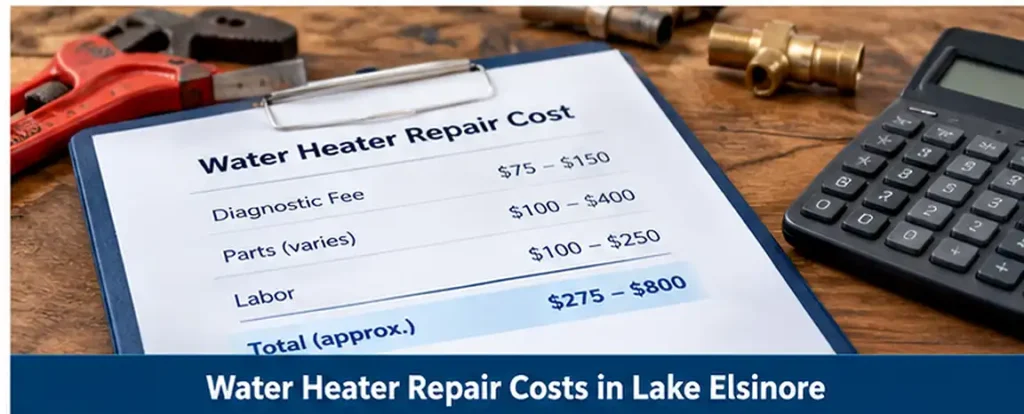
Costs depend on the part, the fuel type, and access. The ranges below reflect typical Southern California market pricing for water heater repair in Lake Elsinore. Final pricing always depends on an on-site diagnosis.
Common Repair Costs
| Repair | Typical Cost Range | Time on Site |
|---|---|---|
| Pilot relight / diagnostic | $100–$200 | 30–60 min |
| Thermocouple replacement | $150–$300 | 45–60 min |
| Heating element (electric) | $200–$400 | 1–2 hrs |
| Thermostat replacement | $200–$400 | 1–2 hrs |
| Anode rod replacement | $200–$450 | 1 hr |
| T&P relief valve | $150–$350 | 1 hr |
| Gas control valve | $350–$750 | 1–2 hrs |
| Tank flush | $100–$250 | 1 hr |
| Tankless descale | $150–$350 | 1–2 hrs |
| Dip tube replacement | $150–$300 | 1 hr |
Replacement Cost Comparison
| Water Heater Type | Installed Cost Range | Typical Lifespan |
|---|---|---|
| 40–50 gal gas tank | $1,800–$3,500 | 8–12 years |
| 40–50 gal electric tank | $1,500–$3,000 | 10–13 years |
| Gas tankless | $3,500–$7,000 | 20+ years |
| Heat pump (hybrid) | $3,500–$6,500 | 13–15 years |
At Bob’s Emergency Plumbing, we believe in transparent pricing. You should get a written estimate before any work begins. Ask for the part cost, the labor cost, and the permit fee as separate line items.
Request an itemized quote on your next call and compare it against the ranges above.
Tankless vs. Tank Water Heaters in Lake Elsinore
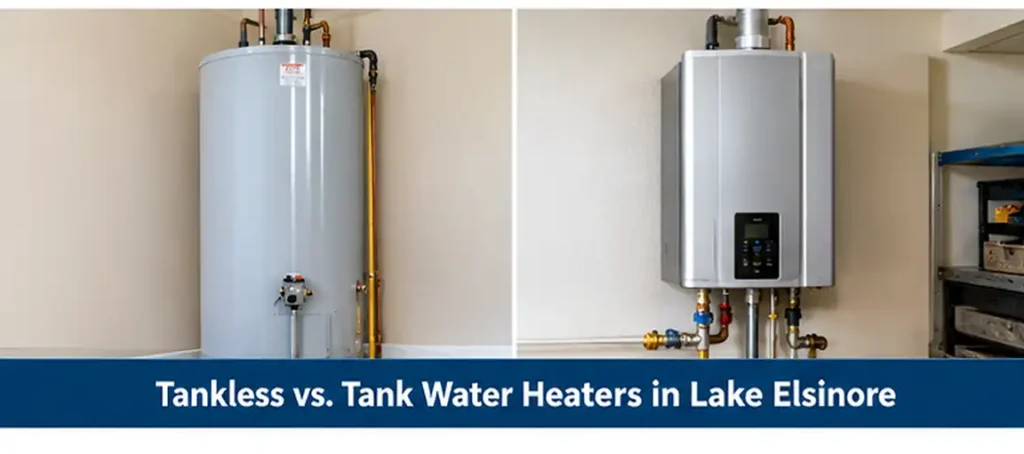
A tankless water heater heats water on demand, so there is no stored tank to keep hot. A tank water heater stores 30 to 80 gallons and keeps it heated around the clock. Both work in Lake Elsinore. The difference is in upfront cost, lifespan, and maintenance needs.
According to the U.S. Department of Energy’s water heating guidance, tankless units can be 24% to 34% more energy efficient than tank models for homes using 41 gallons or less of hot water per day. Savings shrink in homes with heavy daily use.
Water Heater Types and Efficiency
| Feature | Gas Tank | Electric Tank | Gas Tankless | Heat Pump |
|---|---|---|---|---|
| Upfront cost | Low | Lowest | High | High |
| Energy efficiency | Moderate | Moderate | High | Highest |
| Lifespan | 8–12 yrs | 10–13 yrs | 20+ yrs | 13–15 yrs |
| Hot water supply | Limited by tank | Limited by tank | Endless | Limited by tank |
| Hard water sensitivity | Sediment buildup | Element scaling | Heat exchanger scale | Element and coil scale |
| Annual maintenance | Flush | Flush, check elements | Descale | Flush, clean filter |
| Space needed | Large | Large | Wall-mounted | Large, needs airflow |
Why Tankless Units Need Extra Care Here
Tankless systems are increasingly common in newer Canyon Hills and Tuscany Hills homes. Hard water hits them hard. Scale coats the heat exchanger, triggers error codes, and cuts flow.
Brands like Navien, Rinnai, and Noritz all recommend periodic descaling. In hard water areas, plan on once a year. Make sure your installer adds isolation valves, which let a technician descale without cutting into pipes.
If you are weighing a tankless conversion, count your household’s daily hot water use first, then compare that number against the DOE efficiency threshold.
California Code Requirements for Water Heaters
California has stricter water heater rules than most states. Every replacement must meet the California Plumbing Code. Any honest quote for water heater repair Lake Elsinore residents receive should flag code gaps on older installs.
| Requirement | What It Means | Why It Matters |
|---|---|---|
| Seismic strapping | Two straps, one in the upper third and one in the lower third of the tank | Stops the tank from tipping and breaking gas lines in an earthquake |
| Lower strap placement | At least 4 inches above the controls | Keeps straps clear of the gas valve |
| Expansion tank | Required on closed systems with a check valve or pressure regulator | Absorbs pressure from heated water and protects the T&P valve |
| T&P discharge line | Full-size pipe running to an approved location, no threads at the end | Safely releases scalding water during overpressure |
| Proper venting | Correct vent size, slope, and clearance per manufacturer | Prevents carbon monoxide backdrafting |
| 18-inch elevation | Gas units in garages raised so ignition source is 18 inches off the floor | Reduces fire risk from gasoline vapors |
| Permit and inspection | Required for replacements in most California cities | Confirms the install is safe and legal |
| Drain pan | Required where a leak could damage the building | Contains leaks before they spread |
If you’ve spent a freezing winter in New Jersey, protecting your pipes from ice makes complete sense. In California, earthquake strapping makes the same kind of sense. It is cheap insurance against a very expensive day.
Look at your tank right now and count the straps. If you see fewer than two, add a code check to your next service visit.
Annual Water Heater Maintenance Checklist
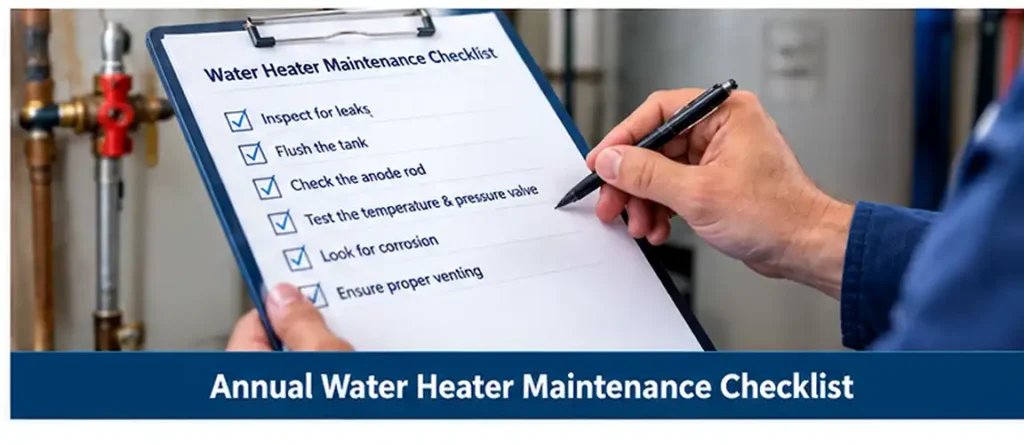
Annual maintenance is the single best way to extend water heater life in hard water areas. The EPA WaterSense program also notes that routine home maintenance saves both water and money on utility bills.
Maintenance Schedule
| Task | Frequency | DIY or Pro |
|---|---|---|
| Flush tank | Every 12 months | DIY or pro |
| Descale tankless unit | Every 12 months | Pro recommended |
| Test T&P relief valve | Every 12 months | DIY |
| Inspect anode rod | Every 2–3 years | Pro recommended |
| Check for leaks and corrosion | Every 3 months | DIY |
| Check seismic straps | Every 12 months | DIY |
| Inspect venting | Every 12 months | Pro recommended |
| Clean tankless inlet filter | Every 6 months | DIY |
| Verify thermostat at 120°F | Every 6 months | DIY |
How to Flush a Tank Water Heater
- Turn off power or gas. Set gas units to “Pilot” or “Off.”
- Close the cold water supply valve.
- Open a hot water faucet in the house to break the vacuum.
- Connect a garden hose to the drain valve and run it outside.
- Open the drain valve and let the tank empty.
- Briefly open the cold supply to stir up remaining sediment.
- Close the drain valve once water runs clear.
- Refill the tank with the hot faucet still open until water flows steadily.
- Restore power or relight the pilot.
Quick Monthly Checks
- Listen for rumbling during a heating cycle
- Look for moisture around the base and fittings
- Watch hot water color at the kitchen tap
- Notice reheat time after showers
- Smell for gas near the unit
Set a phone reminder for your next flush date before you finish reading this article.
What a Professional Repair Visit Includes
A professional visit follows a clear sequence. You should know what to expect before anyone opens your unit.
Our plumbers handle each visit the same way:
- Listen to your symptom description and note the unit’s age.
- Inspect the unit for leaks, corrosion, and code gaps.
- Test key components like the thermostat, thermocouple, elements, and T&P valve.
- Explain the fault in plain language.
- Give a written estimate with repair and replace options.
- Complete the work once you approve.
- Test the system and confirm hot water is restored.
- Clean up and haul away old parts.
If the inspection turns up problems beyond the water heater, such as corroded supply lines or a failing shutoff valve, our plumbing repair team can address those during the same visit.
Prepare a short list of questions about warranty, permits, and part brands before the technician arrives.
FAQs
How long do water heaters last in Lake Elsinore?
Tank water heaters last 8 to 12 years in hard water areas. Tankless units can reach 20 years or more with annual descaling. Skipping maintenance can cut either lifespan by several years.
How much does water heater repair Lake Elsinore homeowners need usually cost?
Most single-part repairs fall between $150 and $750. Simple fixes like a thermocouple sit at the low end. Gas control valves sit at the high end.
Is a leaking water heater an emergency?
Yes, if the leak comes from the tank body or is actively spreading. Shut the cold supply valve and power first. A slow drip from a fitting can usually wait a day.
Do I need a water softener in Lake Elsinore?
A water softener reduces the minerals that cause sediment and scale. It is not required, but it extends water heater life in hard water areas. Ask your plumber to check your hardness before buying one.
Do I need a permit to replace a water heater in California?
Yes. Most California cities require a permit for replacements. The inspection confirms strapping, venting, and expansion tank requirements are met.
Why does my water heater make popping noises?
Popping means sediment has built up on the tank floor. Water trapped beneath it boils and bursts through. A flush usually fixes it if the tank is not too far gone.
What temperature should my water heater be set to?
Set it to 120°F. That temperature balances comfort, energy savings, and scald prevention for most households.
Can a tankless water heater be repaired?
Yes. Most tankless problems, including error codes, scale buildup, and flow sensor faults, are very fixable. Descaling solves many issues in hard water areas.
Protect Your Water Heater Before It Fails
Hard water will keep working against your water heater every day. You control how much damage it does. A yearly flush, a quick strap check, and early attention to rumbling or rust keep you ahead of the problem.
Start today: find your serial number, decode the age, and match it against the repair vs. replace table above. Then schedule your annual flush or descale before the next symptom shows up.